

Annual Report 2024
Department of Plastic and Reconstructive Surgery
Takuya Higashino, Azusa Oshima, Takeaki Hidaka, Ryosuke Matsusaka, Shu Suzuki, Daiju Goto, Kiichi Furuse
Introduction
The Department of Plastic and Reconstructive Surgery mainly focuses on surgical reconstruction following cancer ablation. Reconstructive procedures using free flap transfer with microvascular anastomosis are the most important operations in our institution. In addition, several methods such as tissue transfer with pedicled flaps, local flaps, and skin grafting are used for reconstructive surgery. The objectives of reconstructive surgery are not only the morphological reconstruction, but also the restoration of postoperative functions after ablative surgery. The quality of life (QOL) of patients can be improved with functional and morphological reconstruction.
The Team and What We Do
Two plastic surgeons cover reconstructive operations in the National Cancer Center Hospital (NCCH) East in Kashiwa. The reconstructive surgeries are performed in cooperation with surgeons from other departments within the hospital, such as the Departments of Head and Neck Surgery, Breast Surgery, Esophageal Surgery, Thoracic Surgery, and Colorectal Surgery (Table 1).
Table 1. Number of patients (April 2024 to March 2025)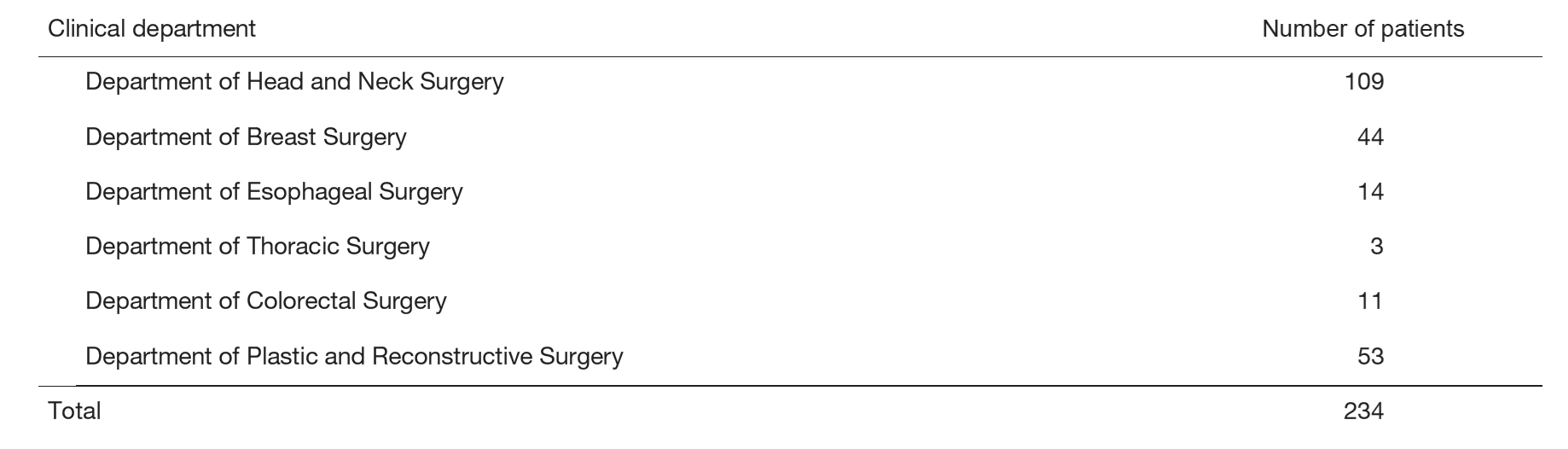
In the NCCH East, head and neck reconstruction is the most frequently performed operation accounting for approximately 50% of the reconstructive surgeries. Free jejunal transfer, anterolateral thigh flap transfer, and rectus abdominis musculocutaneous flap transfer are the frequently used procedures in the head and neck region (Table 2). A weekly conference is held with doctors of the Departments of Head and Neck Surgery, Radiation Oncology, and Head and Neck Medical Oncology. Breast reconstruction using autologous tissue transfer was employed in 2003. Since then, patients’ needs for breast reconstruction have increased. Furthermore, lymphatico-venular anastomosis as a surgical treatment for lymphedema of the extremities was introduced in 2013.
Table 2. Operative procedures (April 2024 to March 2025)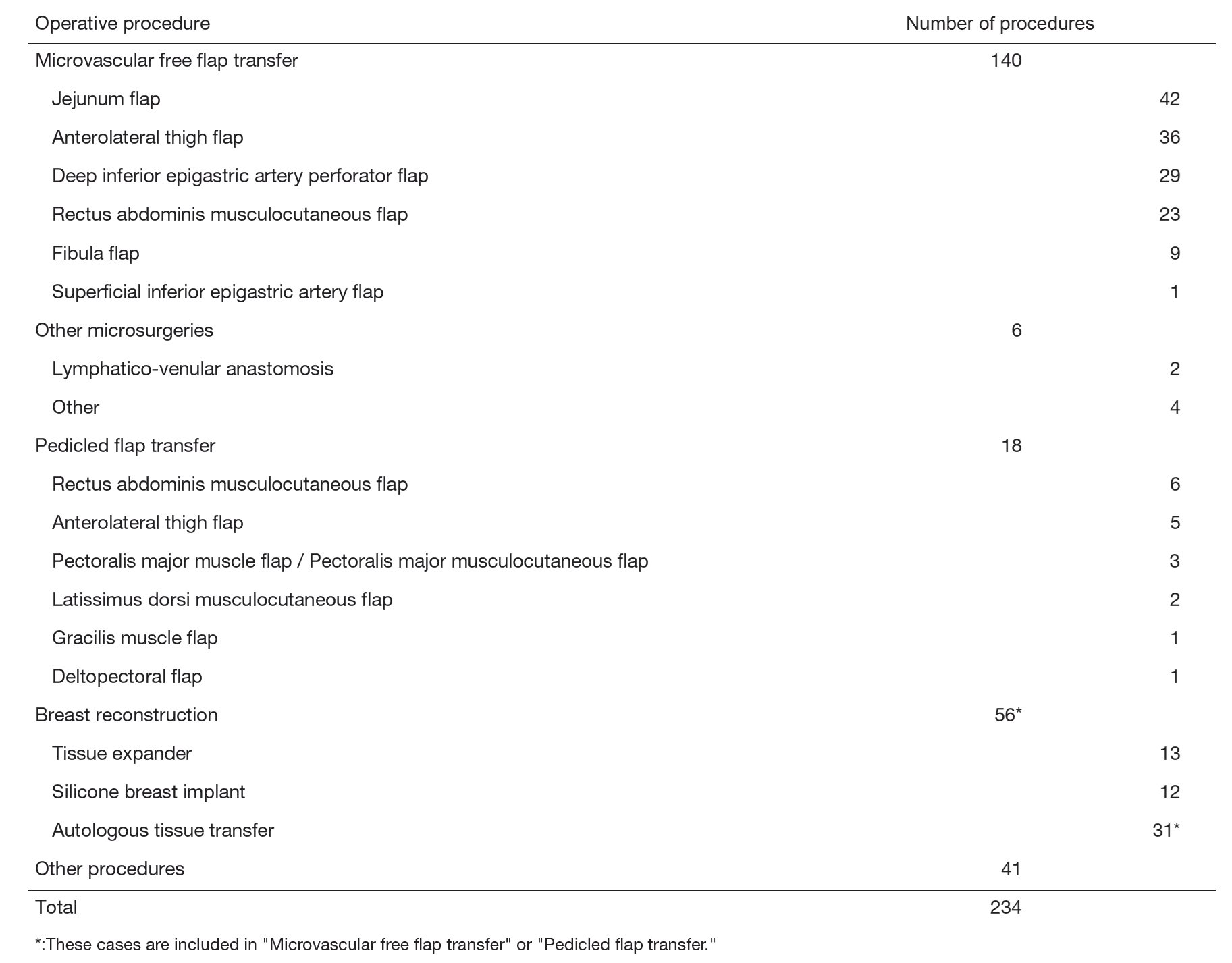
Research Activities
Plastic and reconstructive surgery has focused on the following four aspects in the surgical treatment of cancer to contribute to improving patients’ QOL: 1) obtaining good functional recovery, 2) reducing postoperative complications, 3) achieving less donor site morbidity, and 4) treating postoperative complications after cancer ablation. Establishing a standard for reconstructive surgery and developing new techniques of reconstructive surgery are the most important aims of our studies to address these four aspects. In 2017, we started to take an active role in a new multi-institutional analysis of risk factors for functional outcomes after tongue reconstruction. Additionally, as the principal investigator of the research, we also started the multicenter observational study for evaluating the impact of radiotherapy-related late skin and soft tissue injuries in the neck on QOL of patients with head and neck cancer in 2022. The results of this study were published in a paper in fiscal year 2024.
Education
We accept a large number of young plastic surgeons from all over Japan as residents and train them to become reconstructive surgeons. We also train them to become future opinion leaders in the field of reconstructive surgery.
Future Prospects
The promotion of multi-institutional studies on reconstructive surgery will provide our patients with high-precision and evidence-based medical services.
List of papers published in 2024
Journal
1. Kondo A, Higashino T, Shimada K, Hashimoto K, Fukunaga Y, Oshima A, Ogawa R. Jejunal artery and vein positioning in free jejunal transfer: Surgical considerations and clinical implications. Journal of plastic, reconstructive & aesthetic surgery : JPRAS, 101:84-89, 2025
2. Hidaka T, Miyamoto S, Furuse K, Fukunaga Y, Oshima A, Shinozaki T, Matsuura K, Wakabayashi M, Higashino T. Impact of Suture Materials on Surgical Site Infection in Oral Oncological Surgery With Free-Flap Reconstruction: Analysis Using Propensity Scores. Annals of plastic surgery, 94:325-329, 2025
3. Furuse K, Kageyama D, Arikawa M, Akazawa S, Higashino T. Extended Anterolateral Thigh Flaps: Maximum Size for Covering Cancerous Defects. Annals of plastic surgery, 94:670-675, 2025
4. Hidaka T, Miyamoto S, Fukunaga Y, Oshima A, Shinozaki T, Matsuura K, Higashino T. Complication Trajectories in Total Pharyngolaryngectomy: Comprehensive Complication Index Analysis. The Laryngoscope, 2025
5. Oshima A, Wakabayashi M, Ikeno T, Matsuura K, Hayashi R, Higashino T. Second free jejunum transfer after flap loss does not affect oral intake: A retrospective case-control study. Journal of plastic, reconstructive & aesthetic surgery : JPRAS, 88:208-223, 2024
6. Hidaka T, Miyamoto S, Furuse K, Oshima A, Matsuura K, Higashino T. Machine learning approach to predict tracheal necrosis after total pharyngolaryngectomy. Head & neck, 46:408-416, 2024
7. Kagaya Y, Takanashi R, Arikawa M, Kageyama D, Higashino T, Akazawa S. The Ischemic Tolerance up to Four Hours of Free Jejunum Flap: A Retrospective Cohort Study. Journal of reconstructive microsurgery, 40:407-415, 2024
8. Furuse K, Nara M, Kageyama D, Arikawa M, Akazawa S, Daiko H, Higashino T. Pectoralis Major Muscle Flap Utilization in Salvage Esophagectomy Including Great Vessel Resection Reconstructed by Prosthetic Grafts. Annals of plastic surgery, 92:401-404, 2024
9. Yamamoto T, Shinozaki T, Nishiya Y, Okano W, Tomioka T, Matsuura K, Furuse K, Oshima A, Higashino T, Hayashi R. Early enteral nutrition and mobilization following head and neck surgery with free flap reconstruction. Japanese journal of clinical oncology, 54:770-777, 2024
10. Hidaka T, Miyamoto S, Oba J, Furuse K, Oshima A, Matsuura K, Higashino T. Reconstruction techniques using free jejunal transfer for total pharyngolaryngectomy with total glossectomy. Microsurgery, 44:e31204, 2024
11. Hidaka T, Fukunaga Y, Miyamoto S, Higashino T. Development of a Training Model for Microvascular Tongue Reconstruction. Microsurgery, 44:e31247, 2024
12. Furuse K, Kageyama D, Arikawa M, Akazawa S, Higashino T. Managing Wound Complications After Osteosarcoma Resection: Stopping Adjuvant Therapy and Performing Secondary Closure. Cureus, 16:e74365, 2024
13. Higashino T, Wakabayashi M, Zenda S, Yasunaga Y, Araki J, Mukaigawa T, Onitsuka T, Nakagawa M, Hamahata A, Narita K, Arikawa M, Takanari K, Kadota H, Yanagisawa D, Tanaka K, Matsumoto H, Kimata Y, Miyamoto S, Sakuraba M, Kawai K, Terao Y, Hyodo I, Ishida K, Yoshimura K. Impact of radiotherapy-related late toxicities of skin and soft tissue in the neck on quality of life in head and neck cancer patients: a multi-institutional observational study in Japan. Supportive care in cancer, 33:64, 2024