

Annual Report 2024
Department of Colorectal Surgery
Masaaki Ito, Yuichiro Tsukada, Koji Ikeda, Nobuyoshi Takeshita, Hiro Hasegawa, Daichi Kitaguchi, Yuji Nishizawa, Keisuke Obuchi, Jun Kataoka, Shoma Sasaki, Naoe Yanagisawa, Fumiaki Tokito, Nariaki Okamoto, Kazuki Otani, Yuki Tadokoro
Introduction
Our department specializes in surgical treatment for malignant tumors of the colon and rectum, with a particular focus on low rectal cancers located near the anus. We have performed a large number of advanced function-preserving procedures, especially intersphincteric resection (ISR), aiming to preserve anal function after surgery.
For patients with pelvic malignancies, we collaborate closely with the urology and gynecology departments to achieve both oncological curability and preservation of urinary, reproductive, and sexual functions.
In 2024, we performed more than 700 colorectal operations, including 193 for colon cancer and 242 for rectal cancer (Table 1). A substantial proportion of these were sphincter-preserving surgeries for low rectal cancer.
Table 1. Number of surgical cases from Apr. 2024 to Mar. 2025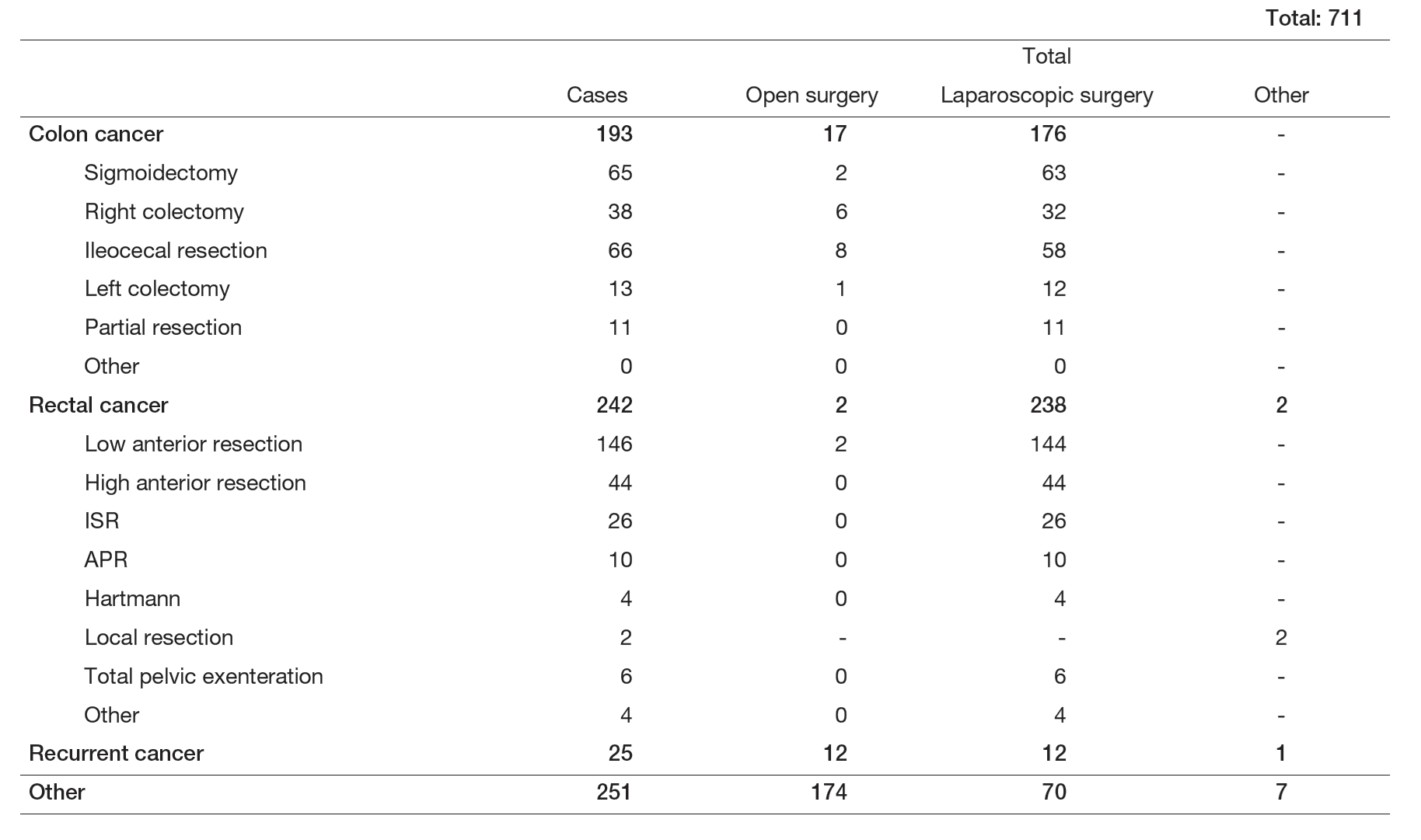
As for new surgical procedures, our department was among the first in Japan to introduce transanal total mesorectal excision (TaTME), an approach that replaces the technically demanding dissection around the anal canal required in conventional laparoscopic surgery. We continue to validate its effectiveness in improving oncological outcomes and functional preservation.
The postoperative anastomotic leakage rate has markedly decreased to 2-3%, and our cumulative number of TaTME cases ranks among the highest worldwide.
We have also introduced robot-assisted surgeries using both the ANSUR surgical robot-developed in collaboration with the NEXT Medical Device Center-and the da Vinci Surgical System.
For locally advanced rectal cancer, we work in close cooperation with medical oncologists and radiation oncologists to improve outcomes by providing preoperative chemoradiotherapy or chemotherapy tailored to individual risk profiles. As a result, the local recurrence rate after rectal cancer surgery has been reduced to below 5%, in line with global standards.
In collaboration with the NEXT Medical Device Center, we are actively engaged in medical device development to enhance surgical quality and safety, focusing particularly on the integration of artificial intelligence (AI) technologies into surgical navigation and support systems.
The Team and What We Do
The Department of Colorectal Surgery comprises 7 colorectal surgeons and 8 residents. The outpatient clinic is open five days a week. More than 400 new patients with colorectal carcinomas visited this department during the last year. Treatment plans are discussed at a weekly conference of a multidisciplinary team including colorectal and hepatic surgeons, medical oncologists and radiologists. Various treatment strategies, such as local excision and other minimally invasive surgeries using laparoscopy, as well as intensive radical surgeries like total pelvic exenteration, with or without adjuvant chemotherapy or radiotherapy, have been introduced for the treatment of patients in any of the stages of colorectal cancer. Laparoscopy-assisted operations with more extensive lymphadenectomy or combined resection of adjacent organs are also increasingly being performed for patients with advanced colorectal carcinomas. Function-preserving surgery to maintain the patient's postoperative QOL, such as intersphincteric resection, have been performed on more than 500 patients with very low rectal tumors. Moreover, a strong point of our team is having extensive experience in the two-team TaTME rectal surgery starting from the abdominal side and the perineal side at the same time, which contributes to shortening the operation time and improving curability. In recent years, the postoperative anastomotic leakage rate for lower rectal cancer has decreased to 2-3%. The postoperative local recurrence rate for rectal cancer has also been less than 5%.
Research Activities
We have published the outcomes of anus-preserving surgery for low rectal cancer based on a multicenter collaborative study (ULTIMATE study) led by our department.
We also developed and standardized the TaTME technique, demonstrating its safety and feasibility through short-term outcomes.
Furthermore, we reported multiple achievements in AI-based surgical device development.
Collaborative research with the Department of Gastrointestinal Oncology includes clinical trials investigating neoadjuvant chemoradiotherapy combined with immunotherapy and studies on circulating tumor DNA (ctDNA).
We are currently leading several nationwide multicenter phase III trials, such as:
JCOG1612: Evaluating the superiority of preoperative chemoradiotherapy for locally recurrent rectal cancer.
JCOG1801 (RC-SURVIVE): Assessing the efficacy of preoperative chemoradiotherapy as a component of multidisciplinary treatment for locally recurrent rectal cancer.
Clinical Trials
JCOG1612: Evaluating the superiority of preoperative chemoradiotherapy for locally recurrent rectal cancer.
JCOG1801 (RC-SURVIVE): Assessing the efficacy of preoperative chemoradiotherapy as a component of multidisciplinary treatment for locally recurrent rectal cancer.
COLOR III Trial: Transanal vs Laparoscopic TME
Education
We place strong emphasis on developing clinical and research skills among residents and oncology fellows.
Clinically, we have established standardized operative procedures and structured educational programs, resulting in the training of many surgeons who have achieved board certification in endoscopic surgery.
On the research side, trainees are involved from the protocol design stage of clinical trials, fostering the ability to conduct and initiate investigator-driven studies.
Future Prospects
Our goal is to develop rational, minimally invasive treatment strategies for colorectal cancer-especially rectal cancer-that achieve both oncological radicality and optimal postoperative quality of life.
We will continue to pursue innovative surgical approaches and medical device development, as well as to nurture surgeons capable of integrating advanced operative skills with clinical research excellence.
List of papers published in 2024
Journal
1. Sato K, Takenaka S, Kitaguchi D, Zhao X, Yamada A, Ishikawa Y, Takeshita N, Takeshita N, Sakamoto S, Ichikawa T, Ito M. Objective surgical skill assessment based on automatic recognition of dissection and exposure times in robot-assisted radical prostatectomy. Langenbeck's archives of surgery, 410:39, 2025
2. Tsukada Y, Ito M. Reversed anatomy in transanal lateral lymph node dissection: landmarks and pitfalls. Techniques in coloproctology, 29:54, 2025
3. Kato H, Kawai K, Nakano D, Dejima A, Ise I, Natsume S, Takao M, Shibata S, Iizuka T, Akimoto T, Tsukada Y, Ito M. Erratum forDoes Colorectal Stenting as a Bridge to Surgery for Obstructive Colorectal Cancer Increase Perineural Invasion? Journal of the anus, rectum and colon, 9:166, 2025
4. Arakaki S, Takenaka S, Sasaki K, Kitaguchi D, Hasegawa H, Takeshita N, Takatsuki M, Ito M. Artificial Intelligence in Minimally Invasive Surgery: Current State and Future Challenges. JMA journal, 8:86-90, 2025
5. Nakajima K, Takenaka S, Kitaguchi D, Tanaka A, Ryu K, Takeshita N, Kinugasa Y, Ito M. Artificial intelligence assessment of tissue-dissection efficiency in laparoscopic colorectal surgery. Langenbeck's archives of surgery, 410:80, 2025
6. Shimomura M, Yoshimitsu M, Tsukada Y, Ohdan H, Watanabe J, Fukunaga Y, Hirano Y, Sakamoto K, Hamamoto H, Horie H, Matsuhashi N, Kuriu Y, Nagai S, Hamada M, Yoshioka S, Ohnuma S, Hayama T, Otsuka K, Inoue Y, Ueda K, Toiyama Y, Maruyama S, Yamaguchi S, Tanaka K, Suzuki M, Misumi T, Naitoh T, Watanabe M, Ito M, Ultimate Trial Group. Late anastomotic complication after laparoscopic surgery for clinical stage I low rectal cancers located within 5 cm of the anal verge: Sub-analysis of the ultimate trial. Ann Gastroenterol Surg, 0:1-11, 2025
7. Kitaguchi D, Ito M. Correction to Dice Similarity Coefficient Formula. Diseases of the colon and rectum, 67:e304, 2024
8. Yamashita K, Oka S, Yamada T, Mitsui K, Yamamoto H, Takahashi K, Shiomi A, Hotta K, Takeuchi Y, Kuwai T, Ishida F, Kudo SE, Saito S, Ueno M, Sunami E, Yamano T, Itabashi M, Ohtsuka K, Kinugasa Y, Matsumoto T, Sugai T, Uraoka T, Kurahara K, Yamaguchi S, Kato T, Okajima M, Kashida H, Akagi Y, Ikematsu H, Ito M, Esaki M, Kawai M, Yao T, Hamada M, Horimatsu T, Koda K, Fukai Y, Komori K, Saitoh Y, Kanemitsu Y, Takamaru H, Yamada K, Nozawa H, Takayama T, Togashi K, Shinto E, Torisu T, Toyoshima A, Ohmiya N, Kato T, Otsuji E, Nagata S, Hashiguchi Y, Sugihara K, Ajioka Y, Tanaka S. Clinicopathological features and prognosis of primary small bowel adenocarcinoma: a large multicenter analysis of the JSCCR database in Japan. Journal of gastroenterology, 59:376-388, 2024
9. Ito M, Tsukada Y, Watanabe J, Fukunaga Y, Hirano Y, Sakamoto K, Hamamoto H, Yoshimitsu M, Horie H, Matsuhashi N, Kuriu Y, Nagai S, Hamada M, Yoshioka S, Ohnuma S, Hayama T, Otsuka K, Inoue Y, Ueda K, Toiyama Y, Maruyama S, Yamaguchi S, Tanaka K, Suzuki M, Naitoh T, Ando K, Watanabe M. Long-term survival and functional outcomes of laparoscopic surgery for clinical stage I ultra-low rectal cancers located within 5 cm of the anal verge: A prospective phase II trial (Ultimate trial). Annals of surgery, 281:304-311, 2024
10. Suzuki Y, Hasegawa H, Mori T, Teramura K, Tsukada Y, Sasaki T, Kojima M, Ito M. Cytological Analysis of the Surgical Field During Transanal Total Mesorectal Excision for Rectal Cancer: A Prospective Study. Diseases of the colon and rectum, 67:1009-1017, 2024
11. Shigaki T, Hasegawa H, Teramura K, Takeshita N, Ikeda K, Tsukada Y, Nishizawa Y, Sasaki T, Ito M. Development of a laparoscopic sigmoidectomy simulator: Sigmaster. Surgery today, 54:1272-1276, 2024
12. Horita K, Hida K, Itatani Y, Fujita H, Hidaka Y, Yamamoto G, Ito M, Obama K. Real-time detection of active bleeding in laparoscopic colectomy using artificial intelligence. Surgical endoscopy, 38:3461-3469, 2024
13. Tsukada Y, Bando H, Inamori K, Wakabayashi M, Togashi Y, Koyama S, Kotani D, Yuki S, Komatsu Y, Homma S, Taketomi A, Uemura M, Kato T, Fukui M, Nakamura N, Kojima M, Kawachi H, Kirsch R, Yoshida T, Sato A, Nishikawa H, Ito M, Yoshino T. Three-year outcomes of preoperative chemoradiotherapy plus nivolumab in microsatellite stable and microsatellite instability-high locally advanced rectal cancer. British journal of cancer, 131:283-289, 2024
14. Sada H, Hinoi T, Niitsu H, Ohdan H, Yamamoto S, Endo S, Hida K, Kinugasa Y, Enomoto T, Maruyama S, Konishi F, Watanabe M. Right-sided versus left-sided colorectal cancer in elderly patients: a sub-analysis of a large multicenter case-control study in Japan. Surgery today, 54:1173-1183, 2024
15. Narihiro S, Kitaguchi D, Hasegawa H, Takeshita N, Ito M. Deep Learning-Based Real-Time Ureter Identification in Laparoscopic Colorectal Surgery. Diseases of the colon and rectum, 67:e1596-e1599, 2024
16. Une N, Kobayashi S, Kudo M, Sugimoto M, Kitaguchi D, Hasegawa H, Ando K, Ikeda K, Nishizawa Y, Tsukada Y, Ito M, Gotohda N. Predictive risk factors for resection surface-related complications after laparoscopic simultaneous resection of primary colorectal tumor and synchronous liver metastases: a single-center retrospective study. Surgical endoscopy, 38:5006-5016, 2024
17. Yoshida M, Kitaguchi D, Takeshita N, Matsuzaki H, Ishikawa Y, Yura M, Akimoto T, Kinoshita T, Ito M. Surgical step recognition in laparoscopic distal gastrectomy using artificial intelligence: a proof-of-concept study. Langenbeck's archives of surgery, 409:213, 2024
18. Ito S, Kinugasa Y, Yamauchi S, Sato H, Hirakawa A, Ishihara S, Shiomi A, Kanemitsu Y, Suto T, Takahashi H, Itabashi M, Shiozawa M, Hiyoshi M, Kobatake T, Komori K, Egi H, Ozawa H, Yamaguchi T, Inada R, Ito M, Hirano Y, Furutani A, Tanabe Y, Ueno H, Ohue M, Hida K, Kawai K, Sunami E, Ishida H, Uehara K, Watanabe J, Hotchi M, Ishibe A, Takii Y, Hiro J, Numata M, Takemasa I, Kato T, Kakeji Y, Hirata A, Ajioka Y. Long-term Outcome After Surgical Resection of Para-aortic Lymph Node Metastasis of Colorectal Cancer: A Multicenter Retrospective Study. Diseases of the colon and rectum, 67:1423-1436, 2024
19. Kato H, Kawai K, Nakano D, Dejima A, Ise I, Natsume S, Takao M, Shibata S, Iizuka T, Akimoto T, Tsukada Y, Ito M. Does Colorectal Stenting as a Bridge to Surgery for Obstructive Colorectal Cancer Increase Perineural Invasion? Journal of the anus, rectum and colon, 8:195-203, 2024
20. Nakamura Y, Tsukada Y, Matsuhashi N, Murano T, Shiozawa M, Takahashi Y, Oki E, Goto M, Kagawa Y, Kanazawa A, Ohta T, Ouchi A, Bando H, Uchigata H, Notake C, Ikematsu H, Yoshino T. Colorectal Cancer Recurrence Prediction Using a Tissue-Free Epigenomic Minimal Residual Disease Assay. Clinical cancer research, 30:4377-4387, 2024
21. Nakajima K, Kitaguchi D, Takenaka S, Tanaka A, Ryu K, Takeshita N, Kinugasa Y, Ito M. Automated surgical skill assessment in colorectal surgery using a deep learning-based surgical phase recognition model. Surgical endoscopy, 38:6347-6355, 2024
22. Kitaguchi D, Ito M. Dissection layer selection based on an understanding of pelvic fascial anatomy in transanal total mesorectal excision. Annals of coloproctology, 40:375-383, 2024
23. Shiraishi T, Nishizawa Y, Nakajima M, Kado R, Ogawa H, Naomi S, Owada Y, Enomoto T, Yazawa S, Hamahata Y, Isogami Y, Kitagawa K, Sakamoto M, Enomoto H, Egawa A, Kitaguchi D, Hasegawa H, Ikeda K, Tsukada Y, Ito M. Prospective Multicenter Study to Clarify the Frequency of Peristomal Skin Disorders and Appropriate Evaluation Time in Patients with Malignant Rectal Tumors. Annals of surgery, 2024
24. von der Heyde S, Raman N, Gabelia N, Matias-Guiu X, Yoshino T, Tsukada Y, Melino G, Marshall JL, Wellstein A, Juhl H, Landgrebe J. Tumor specimen cold ischemia time impacts molecular cancer drug target discovery. Cell death & disease, 15:691, 2024
25. Shinto E, Ike H, Ito M, Takahashi K, Ohue M, Kanemitsu Y, Suto T, Kinugasa T, Watanabe J, Hida JI, Itabashi M, Ozawa H, Nozawa H, Hashiguchi Y, Hase K, Sugihara K, Ajioka Y. Lateral node metastasis in low rectal cancer as a hallmark to predict recurrence patterns. International journal of clinical oncology, 29:1896-1907, 2024
26. Honda R, Kitaguchi D, Ishikawa Y, Kosugi N, Hayashi K, Hasegawa H, Takeshita N, Ito M. Deep learning-based surgical step recognition for laparoscopic right-sided colectomy. Langenbeck's archives of surgery, 409:309, 2024
27. Sunakawa T, Kitaguchi D, Kobayashi S, Aoki K, Kujiraoka M, Sasaki K, Azuma L, Yamada A, Kudo M, Sugimoto M, Hasegawa H, Takeshita N, Gotohda N, Ito M. Deep learning-based automatic bleeding recognition during liver resection in laparoscopic hepatectomy. Surgical endoscopy, 38:7656-7662, 2024