

Annual Report 2024
Department of Urology
Hitoshi Masuda, Yasukazu Nakanishi, Shugo Yajima, Madoka Kataoka, Kohei Hirose, Naoki Imasato, Ken Sekiya, Minoru Inoue, Ryo Andy Ogasawara
Introduction
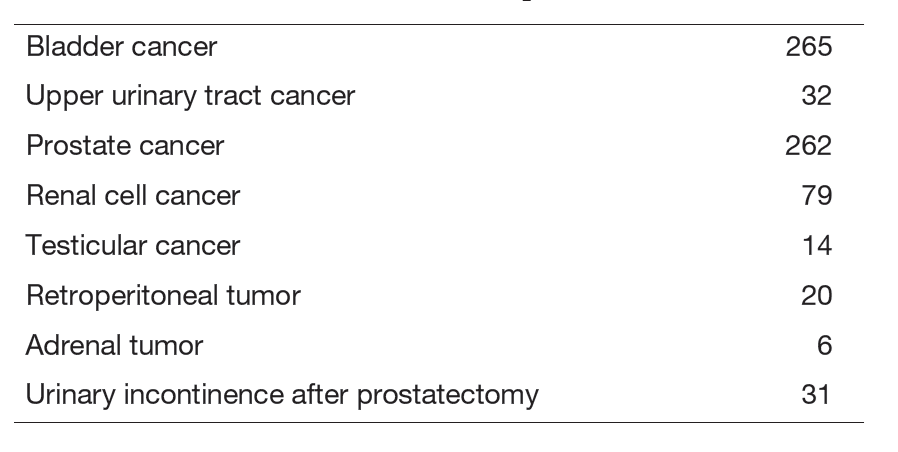
The Department of Urological Surgery has existed as part of the Department of Pelvic Surgery at the National Cancer Center Hospital East since 2003. This department primarily treats all urogenital malignant diseases, including kidney cancer, urothelial cancer, prostate cancer, testicular germ cell tumors, adrenal tumors and retroperitoneal sarcomas. We usually perform minimally invasive surgeries such as robotic, laparoscopic and minimum incision endoscopic surgery, preserving the sexual and/or voiding functions in prostate cancer and organ function, especially in kidney cancer. Beyond preserving function, we have actively performed many reconstructive procedures to restore function.
The Team and What We Do
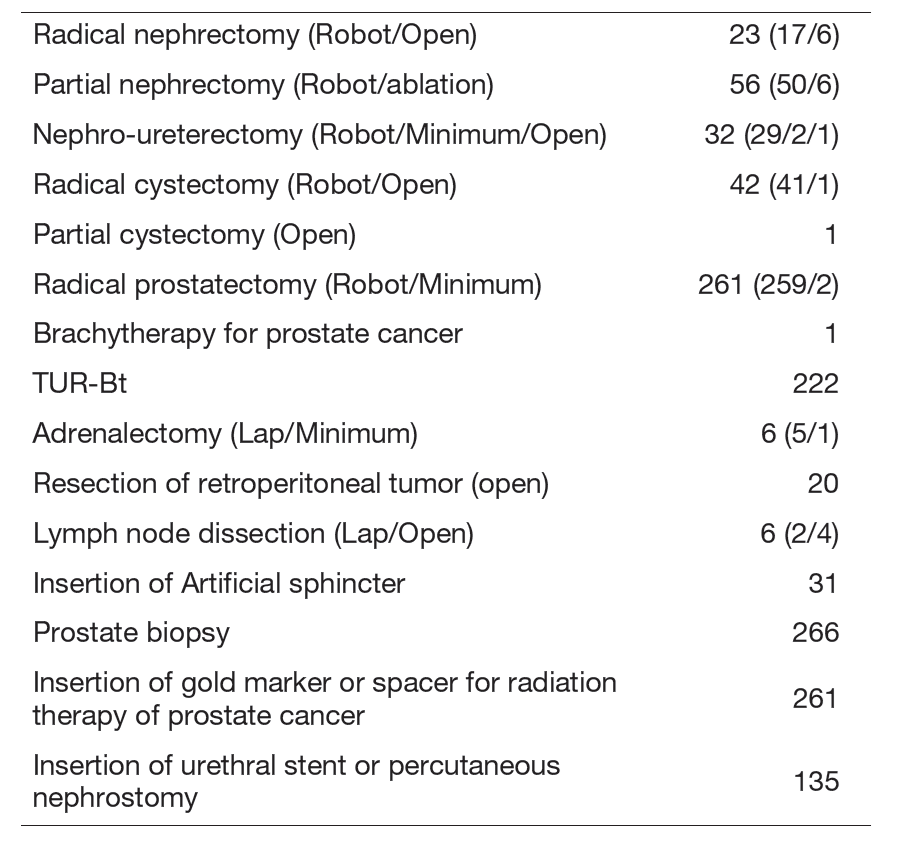
1. Outpatient activities: Our outpatient clinic is open five days a week, performing flexible cystoscopy, abdominal ultrasonography and retrograde pyelography. Superficial bladder cancer (G3, cis, or recurrent tumor) after TUR-Bt is treated by instillation of BCG into the bladder. Cases of advanced urogenital cancers including metastatic prostate cancer are referred to the medical oncology division for chemotherapy or hormonal therapy. Extrinsic upper urinary tract obstructions that directly result from invasion of an adjacent malignancy or peritoneal metastasis are also treated in our department. The selection of internal stenting or percutaneous nephrostomy depends on the malignancy type and degree of obstruction. In 2024, 104 patients newly received ureteral stents and 31 underwent nephrostomy for obstructive uropathy. Moreover, 261 patients newly received insertion of markers or spacers for radiation therapy for localized prostate cancer in 2024.
2. Inpatient activities: A daily conference is held for diagnosis and treatment of patients with urological cancer. Surgeries, especially all robotic surgeries, have consistently increased over time. This year, 1150 surgeries were performed in the Department of Urology. Moreover, we performed 34 combination surgeries with colorectal surgeons in 2024.
3. Other: We have a conference on urogenital cancers every other week among medical oncologists, radiation oncologists, and pathologists. Neoadjuvant chemotherapy for muscle-invasive bladder cancer, combination hormone and radiation therapy for prostate cancer, treatment strategies for metastatic renal cell carcinoma and testicular cancer, and so on are determined in the meeting.
Research Activities
1. We investigated the risk factors for the progression of high-risk superficial bladder cancer. Additionally, we investigated the resistant mechanisms of BCG therapy for high-risk superficial bladder cancer.
2. We investigated the usefulness of novel techniques in robot surgeries including radical prostatectomy and nephroureterectomy.
3. We performed clinical trials, including fat-derived stem cell therapy for urinary incontinence after radical prostatectomy and mobile health intervention for robot-assisted radical prostatectomy.
4. We investigated the risk factors of complications after urinary sphincter implantation.
5. We investigated the geriatric assessment in urological cancer patients.
6. We are investigating exosome-based liquid (urine) biopsy in urothelial cancers.
7. We are performing implementation of AI technologies in pelvic surgery.
8. We are working on the development of an innovative transurethral surgical device for bladder tumor management.
9. We are investigating the relationship between physical activity and cancer biology based on SCRUM-MONSTAR LIFGLOG study.
Clinical Trials
1. A phase III study: Pirarubicin instillation after nephroureterectomy for upper tract urothelial carcinoma (JCOG1403)
2. A phase III clinical study: Pembrolizumab in MIBC (MK-3475-866)
3. A phase III clinical study: Enfortumab Vedotin and Pembrolizumab in MIBC (MK-3475-905)
4. A prospective observational study: QOL using a wearable device for SUI after radical prostatectomy
5. A prospective clinical study: Fat-derived stem cell therapy for SUI after radical prostatectomy
6. A prospective clinical study: Preventive effect of drug for postoperative delirium
Education
We accepted five voluntary residents of urology in 2024 and taught urological surgery and clinical study.
Future Prospects
1. We will develop new and useful techniques for robot-assisted surgeries of the prostate, bladder, upper urinary tract and kidney.
2. We will start a multicenter clinical trial of stem cell therapy for urinary incontinence after radical prostatectomy.
3. We will develop a new two-arm transurethral surgical system for en bloc resection of bladder tumor.
4. We will establish exosome-based liquid (urine) biopsy in urothelial cancers.
5. We are aiming for regulatory approval of AI technologies in pelvic surgery.
List of papers published in 2024
Journal
1. Nakanishi Y, Imasato N, Ogasawara RA, Hirose K, Sekiya K, Katsumura S, Kataoka M, Yajima S, Masuda H. Novel model of the region of interest modified Mayo Adhesive Probability score. World journal of urology, 43:61, 2025
2. Hirose K, Nakanishi Y, Ogasawara RA, Imasato N, Inoue M, Sekiya K, Kataoka M, Hojo H, Yajima S, Zenda S, Masuda H. Risk factors for rectal wall infiltration in hydrogel spacer placement: Influence of biopsy approach. International journal of urology, 32:183-189, 2025
3. Imasato N, Yajima S, Ogasawara RA, Inoue M, Hirose K, Sekiya K, Kataoka M, Nakanishi Y, Masuda H. Salvage robot-assisted radical prostatectomy with pelvic lymph node dissection for radiorecurrent prostate cancer in a patient with a previous history of rectal cancer surgery. IJU case reports, 8:104-107, 2025
4. Yajima S, Hata S, Masumori N, Matsuoka Y, Sawada A, Miki J, Tambo M, Kobayashi Y, Matsuda A, Nakane K, Kobayashi T, Tanaka H, Yamaguchi N, Kaneko G, Miller R, Seto T, Ito H, Kikuchi E. Patient Preferences for Post-Radical Cystectomy Treatment in Muscle-Invasive Bladder Cancer: A Discrete Choice Experiment in Japan. International journal of urology, 32:688-697, 2025
5. Imasato N, Yajima S, Ogasawara RA, Hirose K, Sekiya K, Katsumura S, Kataoka M, Nakanishi Y, Masuda H. Possible therapeutic effect on nocturia after radical prostatectomy by OnabotulinumtoxinA injection: a case series. Afr J Urol, 31:21, 2025
6. Yajima S, Nakanishi Y, Ogasawara RA, Imasato N, Hirose K, Katsumura S, Kataoka M, Masuda H. Value of Cystatin C-Based Sarcopenia Index in Patients Undergoing Surgery for Renal Tumors. Clinical genitourinary cancer, 22:102051, 2024
7. Yajima S, Nakanishi Y, Ogasawara RA, Imasato N, Hirose K, Katsumura S, Kataoka M, Masuda H. An exploratory study on the heterogeneity of postoperative delirium: Preoperative cognitive screening does not detect hallucinatory delirium risk. European journal of surgical oncology, 50:108243, 2024
8. Yajima S, Nakanishi Y, Ogasawara RA, Imasato N, Hirose K, Katsumura S, Kataoka M, Masuda H. Comparing Preoperative Screening Tools for Elective Urologic Cancer Surgery: Insights from a Cluster Analysis. Gerontology, 70:741-754, 2024
9. Yajima S, Nakanishi Y, Ogasawara RA, Imasato N, Hirose K, Katsumura S, Kataoka M, Masuda H. Value of Flemish Version of the Triage Risk Screening Tool in Predicting Unfavorable Outcomes after Elective Cancer Surgery: A Propensity Score-Matched Retrospective Cohort Study. Biomedicine hub, 9:45-53, 2024
10. Oda S, Kuno H, Hiyama T, Yamaguchi M, Sasaki T, Yajima S, Masuda H, Kobayashi T. Radiologic feature of complications after artificial urinary sphincter implantation following total prostatectomy. Abdominal radiology (New York), 49:2416-2427, 2024
11. Hirose K, Nakanishi Y, Ogasawara RA, Imasato N, Katsumura S, Kataoka M, Yajima S, Masuda H. Robot-Assisted Laparoscopic Radical Prostatectomy for Prostatic Metastatic Recurrence from Testicular Cancer. Case reports in urology, 2024:1941414, 2024
12. Yajima S, Nakanishi Y, Hirose K, Kataoka M, Masuda H. Standardization of robot-assisted radical nephroureterectomy via intraperitoneal approach: insights from a high-volume Japanese Center. Journal of robotic surgery, 18:330, 2024
13. Hirose K, Yajima S, Ogasawara RA, Imasato N, Katsumura S, Kataoka M, Nakanishi Y, Masuda H. Prognostic Impact of Each Item of the SARC-F Questionnaire in Patients Undergoing Major Surgery for Urologic Cancer. Journal of frailty, sarcopenia and falls, 9:201-206, 2024
14. Imasato N, Yajima S, Ogasawara RA, Inoue M, Hirose K, Sekiya K, Kataoka M, Nakanishi Y, Masuda H. Robot-assisted radical prostatectomy in patient with previous intersphincteric resection for rectal cancer. IJU case reports, 7:506-509, 2024
15. Ogasawara RA, Yajima S, Imasato N, Hirose K, Sekiya K, Kataoka M, Nakanishi Y, Masuda H. Hounsfield Unit on Preoperative Computed Tomography as an Indicator of Prognosis in Patients with Liposarcoma. Urology research & practice, 50:187-192, 2024