

Annual Report 2024
Supportive Care Center
Masafumi Ikeda, Hatoe Sakamoto, Kazue Hayasaka, Yoko Iida, Nahoko Kaneko, Yuko Teshigawara, Tokiko Suzuki, Erika Sekine, Emi Takayama, Risako Teshima, Yuta Hirano, Yoshie Murata, Miiko Watanabe, Miwa Yamauchi, Megumi Yamaguchi, Kazuko Ogawa
Introduction
The Supportive Care Center was established as an organization to provide, in addition to conventional consultation support, positive and comprehensive support from a variety of professional occupations for actual or potential, physical, mental, and social problems that cancer patients and their families confront. Our main activities are the establishment of a continuous support system for patients and their families, the enhancement of a home care support system, and the promotion of community cooperation for establishing early palliative care.
The Team and What We Do
1. Consultation support/community medicine cooperation
In 2024, we received 8,846 (up 1.9% over 2023) new consultations. Among them, 7,105 (80.3%) were from patients who had received medical treatment in our hospital, or their families, and 1,741 (19.7%) were from patients who had received medical treatment at other medical institutions, or their families (Table 1).
Table 1. Details of the consultation support provided in 2024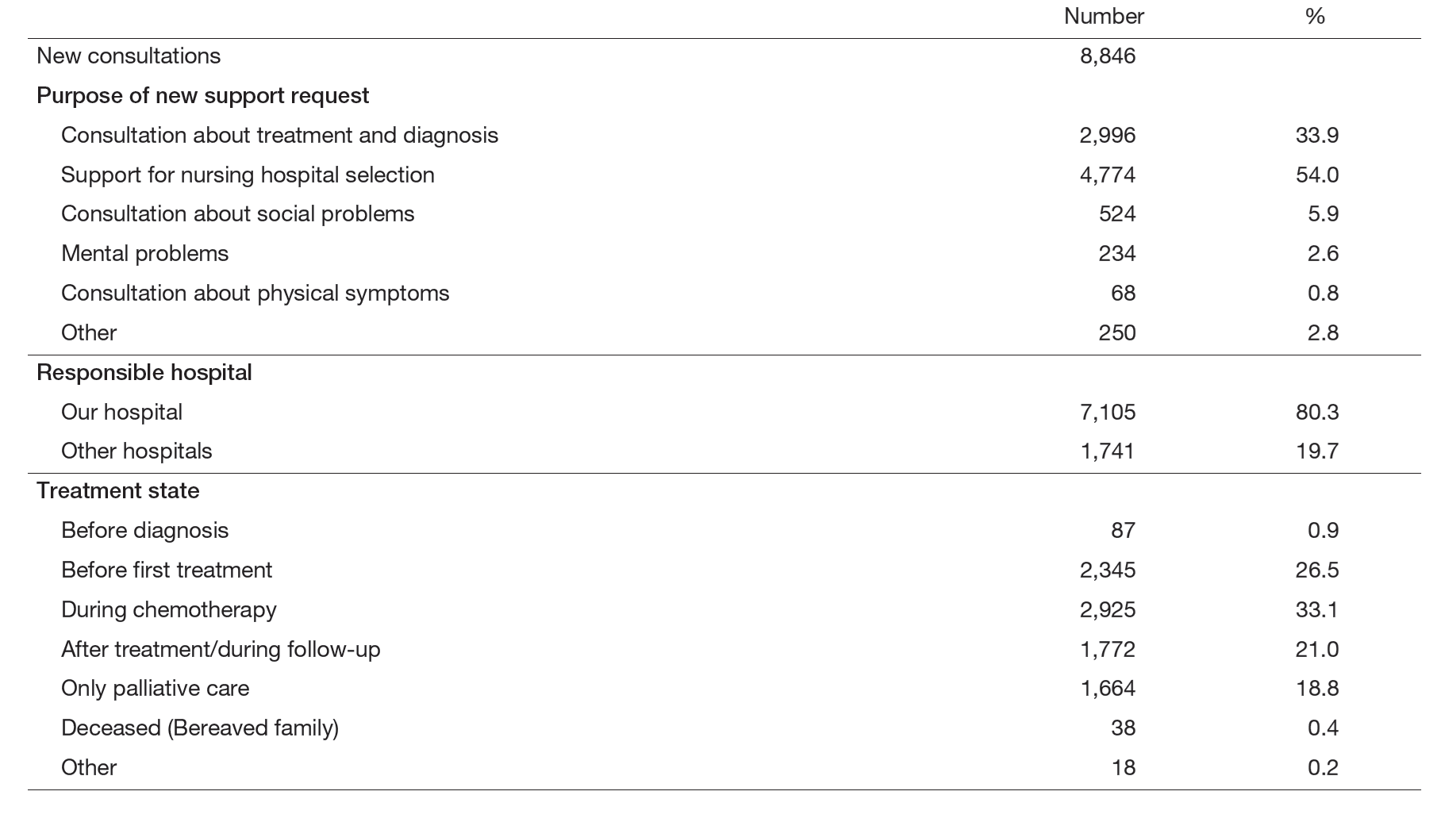
We provided educational services for cancer patients such as pancreatic cancer classes, makeup advice seminars to improve the quality of life of patients under treatment. In 2024, 36 events were held and 769 people participated.
In addition, various webinars for multidisciplinary collaboration aimed at improving the quality of life for patients and their families were conducted. In FY2024, 30 videos were released, which obtained 128,489 views. In addition, two support seminars for patients with cancer were held, which drew the participation of 340 people from across Japan.
Online study sessions on palliative care were held for community health and welfare workers involved in this line of work. As a result of this initiative, the number of participants in various seminars has expanded to patients, families, business establishments, and educators in 47 prefectures in Japan. In the future, we plan to improve the system so that valuable information can be delivered to all those who need it across regions and positions.
2. Employment support
Working in collaboration with Hello Work as well as with licensed social insurance labor consultants and occupational health support centers, we have extended support for a total of 594 cases to facilitate a balance between work and treatment for patients suffering from cancer.
3. Prevention program to improve job turnover rate for cancer patients
"Research for implementation of a program to support cancer patients in balancing treatment and work and finding employment - Creating a sustainable system -" (Grant-in-Aid for Scientific Research on Health, Labour and Welfare) is currently underway.
The project focuses on the following three areas: (1) establishment of a work-sharing system that takes into account the expansion of adaptation to non-regular employment, self-employment, domestic work, and inexperienced employment; (2) identification of issues and needs that arise during long-term treatment and optimization of intervention processes; and (3) attempts to develop practical education programs for cancer specialists and other counselors, in collaboration with patient support groups, cooperating companies, and government agencies. The project will be conducted in collaboration with patient support groups, collaborating companies, and government agencies.
New Initiatives
As part of the practice of palliative care from the time of diagnosis, various support needs were identified using the “Questionnaire on Life in Treatment” for all newly diagnosed patients to facilitate multidisciplinary support. In FY2024, 27.3% of consultations were conducted before the initiation of first treatment (22.4% in FY2021, before the questionnaire’s introduction), indicating the effectiveness of early-stage counseling and support.