

Annual Report 2024
Department of Radiological Technology
Masashi Ito, Junpei Shigenaga, Izumi Okada, Yuichi Nagai, Aika Umemuro, Kyohei Kuribayashi, Chie Sato, Hina Morita, Kei Takahashi, Ayako Inoki, Masashi Shinozaki, Asami Tanaka, Hiroki Miyazaki, Kaori Yanagisawa, Akira Inagaki, Moeka Mizuguchi, Kento Yokota, Kazusa Honda, Kanta Inoue, Kazuyuki Wakamatsu, Toshiyuki Shibuya, Shun Aoyagi, Hiroyuki Ota, Haruki Togo, Amon Osawa, Motoe Kiyama, Saeko Mochinaga, Kei Ozeki, Ritsuko Hirano, Hironori Kajiwara, Kotaro Takahashi, Kai Aoki, Hikari Inagawa, Kaoru Ikeno, Akari Komata, Kei Sato, Tomoki Aizawa, Takeshi Murano, Toshimitsu Sobue, Yuki Miura, Risa Ono, Yuta Suzuki, Shinichi Takahashi, Yuki Mizunuma, Rie Kito, Yuki Tanaka, Kazuhito Kano, Hajime Oyoshi, Toshiya Rachi, Kota Hirotaki, Takashi Someya, Naoki Yamashita, Nene Hashizume, Ken Hirayama, Yuya Fujimoto, Mitsue Nihei, Jun Namatame, Hiroyuki Takano
Clinical practice/research activities
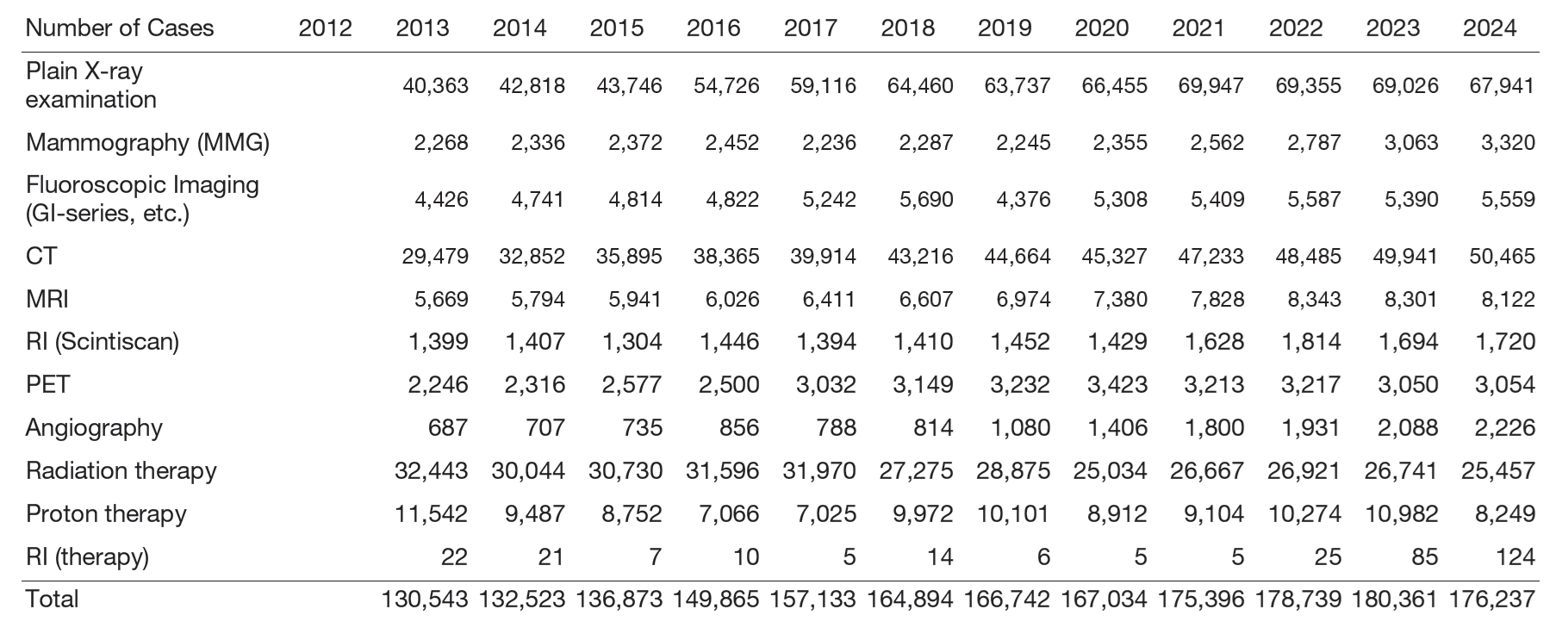
The overall number of cases handled showed a slight decrease of 2% compared to the previous year (Table 1). In radiation therapy, the trend toward hypofractionation of photon beam therapy led to a 5% decrease in the total number of cases, but the number of patients increased slightly by 1%. The number of IMRT patients increased by 5%, indicating a rise in the proportion of high-precision treatments. In diagnostic radiology, the number of CT scans increased by 1%, as usual. Furthermore, in fiscal year 2024, the number of RI treatments (internal therapy) increased by 45% compared to the previous year, following the addition of a dedicated RI treatment ward. Clinical trials are planned for RI internal therapy, with a shift from beta-emitting nuclides to alpha-emitting nuclides. In terms of research activities, we have signed collaborative research agreements with four companies, and are continuing to conduct translational research on clinical technologies, achieving results and even commercialization. Additionally, we are currently continuing to develop high-resolution, high-performance photon-counting CT devices and general radiography inspection systems that utilize AI technology. In the field of radiation therapy, we are continuing to develop automatic plan-checking tools for radiation therapy planning, as we did last year, and are researching improvements and effective uses of neutron activation suppressants in particle beam therapy facilities.
Research results
We have jointly developed and commercialized an application that uses facial recognition technology to systematize the entire process of CT scans, from reception to completion. Furthermore, we are conducting joint research with a company on applying this technology to biometric authentication. For general radiography, we spent four years working with a company on an application that uses AI technology to automatically identify incorrectly positioned areas. The research results were presented at the European Congress of Radiology and the Japanese Society of Radiological Technology, and the resulting product was successfully commercialized. For X-ray mammography, we conducted four years of joint research with a company on the "production of a deformable breast phantom for X-ray mammography quality control," which we have commercialized. This phantom, modeled after a clinical breast, is expected to be used for automated detection of lesions caused by breast compression. In the field of radiation therapy, we have implemented a new linear accelerator function, the dynamic swing arc (intensity-modulated therapy with a non-coplanar rotational orbit), to verify the effectiveness of dose distribution and have implemented it in clinical practice in various areas.
Education
Job rotation is implemented within the hospital to maintain and improve the functionality of each department. The Department of Radiological Technology has six staff members working in various departments, including the Department of Medical Information, Ethical Review Support Section, Medical Affairs Division, Department for the Promotion of Medical Device Innovation, and seconded to the Japan Agency for Medical Research and Development (AMED). The radiological technologist residency program began in April 2022. The first graduates received their certificates in March 2025 and were hired as full-time staff at the hospital on April 1st. Currently, the second, third, and fourth graduates (two, two, and one cancer resident) are undergoing training according to the syllabus and curriculum. The purpose of this program is to train and produce diagnostic radiological technologists with highly specialized knowledge and skills to promote the equalization, development, and expansion of cancer care and to protect the lives and health of the nation. This system consists of two stages: a three-year basic course for cancer specialist technicians (a general practice training course at the Kashiwa campus) and a two-year cancer specialist training course. 56 people participated in the online information session for resident recruitment in 2026, and 16 people participated in the tour.
Future Prospects
As the workload continues to increase, and in light of the shift in tasks, the hospital aims to provide training for the expansion of its work teams and increase the number of people with various certifications. High-quality medical care, research, and education are expected to further enhance the achievements and results of its staff.
List of papers published in 2024
Journal
1. Tomizawa K, Motegi A, Oyoshi H, Fujisawa T, Zenda S, Zhou Y, Nakamura M, Hirata H, Hojo H, Kageyama SI, Hirotaki K, Matsuura K, Akimoto T. Accelerated three-dimensional conformal radiotherapy for early-stage glottic cancer in reducing dose to the internal carotid artery and pharyngeal constrictor muscles. Head & neck, 46:239-248, 2024
2. Hirotaki K, Tomizawa K, Moriya S, Ito M, Sakae T. Impact of Anatomical Position Errors on Dose Distribution in Head and Neck Radiotherapy and Robust Image Registration Against Anatomical Changes. Anticancer research, 43:1827-1834, 2023
3. Hirotaki K, Tomizawa K, Moriya S, Oyoshi H, Raturi V, Ito M, Sakae T. Fully automated volumetric modulated arc therapy planning for locally advanced rectal cancer: feasibility and efficiency. Radiation oncology (London, England), 18:147, 2023