

Annual Report 2024
Department of Head and Neck Surgery
Seiichi Yoshimoto, Go Omura, Chihiro Fushimi, Toshihiko Sakai, Azusa Sakai, Kohtaro Eguchi, Takaaki Hayashi, Akihisa Tanaka, Mitsuhiko Kato, Tatsuya Ito, Takane Watanabe
Introduction
The treatment strategy for head and neck cancer is to enhance survival rates while preserving the significant functions including speech, mastication, swallowing and cosmetic appearance. To achieve this strategy, our department has sought to select the best treatment modality and devise new surgical procedures based on clinical-pathological findings and our extensive database of patients with head and neck cancer.
Our department has developed and performed original surgical procedures for partial or subtotal laryngectomy for newly-diagnosed and radiation-failed laryngeal cancer, partial pharyngectomy for hypopharyngeal cancer and total glossectomy for advanced tongue cancer. These surgical approaches can be performed without sacrificing the larynx. Compared with conventional surgery, there are apparently fewer wound complications. Patients can resume social activities more easily when they maintain their ability to communicate orally.
The Team and What We Do
The Department of Head and Neck Surgery at the NCCH consists of 11 head and neck surgeons. Many operations are performed under general and local anesthesia with or without microsurgical reconstructive surgery. In addition to radiotherapy, concurrent chemo-radiotherapy is performed with the Department of Radiation Oncology and the Department of Head and Neck, Esophageal Medical Oncology. We have many patients with extremely rare malignant diseases, such as head and neck sarcoma. There is therefore a need for greater collaboration with various departments and medical staff.
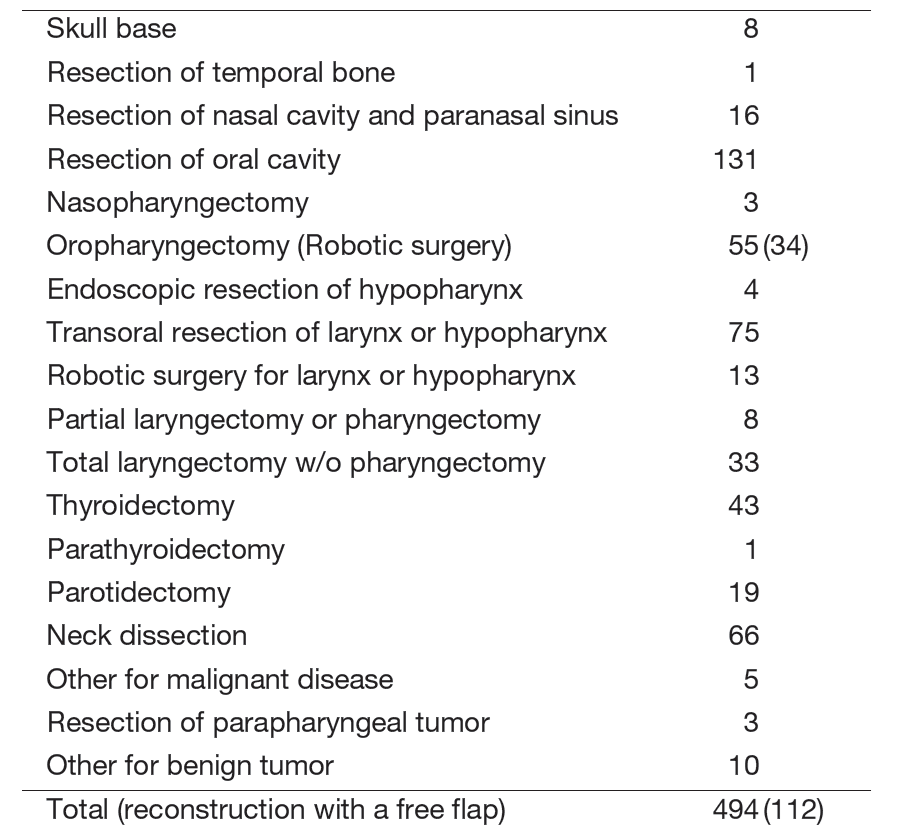
In 2024, 494 patients with head and neck tumors underwent surgery under general anesthesia, including 112 patients with major ablation and free-flap reconstructive surgery. Table 1 shows the number of surgical cases under general anesthesia.
Research Activities
We are performing translational research in collaboration with the Department of Pathology, the Department of Head and Neck, Esophageal Medical Oncology, and research institutes.
Clinical Trials
The phase III study on elective neck dissection for early tongue cancer (JCOG1601) has reached the target accrual, with 23 of the total 441 patients enrolled from our institution. The phase III study on dose de-escalation of elective nodal irradiation in chemoradiotherapy (JCOG1912) enrolled 3 patients from our institution; however, unfortunately, new patient accrual was terminated following the results of the interim analysis. The phase III comparative study conducted in collaboration with the National Cancer Center Hospital East and Miyagi Cancer Center, evaluating the efficacy of preoperative steroid administration for enhancing recovery after reconstructive surgery, has also reached the planned accrual, and the results have been published. In addition, the results of the multicenter phase II study on minimally invasive surgery after induction chemotherapy for locally advanced HPV-positive oropharyngeal cancer have also been reported.
Education
We provide plenty of educational opportunities for resident doctors, with particular focus on acquiring operative techniques. They can learn everything about perioperative management, such as physical examination, image diagnosis, informed consent, preoperative preparation and postoperative management.
Future Prospects
While continuing function-preserving surgery, there will still be a need for extensive resection for advanced cases, including skull base surgery and salvage surgery. On the other hand, transoral robotic surgery with a single port was introduced in our hospital in 2024 and the number of cases is expected to increase in the future. Treatment strategies for HPV-related oropharyngeal cancer will further be developed after obtaining the results from ongoing clinical trials. Immune checkpoint inhibitors are expected to be used in both the neoadjuvant and adjuvant settings for patients with advanced cancer.
List of papers published in 2024
Journal
1. Shinomiya H, Matsuura K, Onimaru R, Ohkoshi A, Saito Y, Tachibana H, Shiga K, Ueda T, Asada Y, Uemura H, Beppu T, Seto A, Yasumatsu R, Nakahira M, Omura G, Asakage T, Minami S, Fujii T, Hirayama Y, Yoshida D, Nakamura K, Sasaki K, Mizusawa J, Fukuda H, Homma A. Dose-finding and efficacy confirmation trial of the superselective intra-arterial infusion of cisplatin and concomitant radiation therapy for locally advanced maxillary sinus cancer (JCOG1212): final analysis. International journal of clinical oncology, 30:489-496, 2025
2. Sakai T, Omura G, Eguchi K, Sakai A, Matsumoto Y, Fushimi C, Yoshimoto S. Prognostic prediction using recursive partitioning analysis of patients undergoing salvage surgery for locally recurrent oral squamous cell carcinoma. International journal of clinical oncology, 30:1118-1126, 2025
3. Koide Y, Kodaira T, Kitayama M, Kawakita D, Kirita T, Yoshimoto S, Nakamizo M, Nibu KI. Definitive radiotherapy for nasopharyngeal carcinoma in Japan: analysis of cases in the National Head and Neck Cancer Registry from 2011 to 2014. Japanese journal of clinical oncology, 54:54-61, 2024
4. Matsumoto Y, Kobayashi K, Eguchi K, Watanabe T, Sakai A, Omura G, Yoshimoto S. Surgical approach through the anterior scalene muscle resection for invasive tumours in the supraclavicular fossa (with video). Japanese journal of clinical oncology, 54:939-944, 2024
5. Ichisaka T, Sano D, Kijima N, Kawakita D, Yoshimoto S, Kitayama M, Nibu KI, Oridate N. Clinical benefits of combining oral cytotoxic chemotherapeutic agents with radiotherapy in patients with T2N0 glottic squamous cell carcinoma based on the reports of the Head and Neck Cancer Registry of Japan. Oral oncology, 157:106942, 2024
6. Shimizu H, Kodaira T, Kiyota N, Hayashi R, Nishino H, Asada Y, Mitani H, Hirayama Y, Onozawa Y, Nishio N, Hanai N, Ohkoshi A, Hara H, Monden N, Nagaoka M, Minami S, Fujii T, Tanaka K, Homma A, Yoshimoto S, Oridate N, Omori K, Ueda T, Okami K, Uemura H, Shiga K, Nakahira M, Asakage T, Saito Y, Sasaki K, Kitabayashi R, Ishikura S, Nishimura Y, Tahara M. Incidence and risk factors associated with the development of hypothyroidism after postoperative chemoradiotherapy for head and neck cancer patients with high-risk features: Supplementary analysis of JCOG1008. Oral oncology, 157:106976, 2024
7. Omura G, Eguchi K, Yoshimoto S, Honma Y, Fushimi C, Sakai T, Matsumoto Y, Sakai A, Kitayama M, Kawakita D, Kirita T, Kodaira T, Nakamizo M, Nibu KI. Survival Outcome Superiority of Total Pharyngolaryngectomy Compared with Chemoradiotherapy for T4aM0 Hypopharyngeal Squamous Cell Carcinoma: A Nationwide Database Study of Japan. Annals of surgical oncology, 31:8206-8213, 2024
8. Hagiwara K, Matsuki T, Okada T, Fushimi C, Kondo T, Takahashi H, Okamoto I, Tokashiki K, Hanyu K, Kishida T, Ito T, Yamashita G, Tsukahara K, Masubuchi T, Tada Y, Momiyama K, Yaguchi R, Oridate N, Omura GO, Yamashita T. Role of Hematological Markers in Recurrent/Metastatic Head and Neck Squamous Cell Carcinoma Treated With Pembrolizumab. Anticancer research, 44:4057-4072, 2024