

Annual Report 2024
Department of Dermatologic Oncology
Naoya Yamazaki, Kenjiro Namikawa, Dai Ogata, Eiji Nakano, Yuichi Nakayama
Introduction
The Department of Dermatologic Oncology has been the core institution in Japan for the development of treatment for melanoma and non-melanoma skin cancers since the National Cancer Center was established in 1962. To date, more than 4,000 cases of malignant melanoma have been registered—an outstanding number for a single hospital in Japan. Patients are referred to our hospital from all regions of the country and even from overseas, and most receive diagnosis and treatment for melanoma or non-melanoma skin cancers. Surgery remains the mainstay of management, while multidisciplinary approaches—immunotherapy, targeted therapy, chemotherapy, and radiotherapy—are routinely applied. Among these, immunotherapy has gained particular importance, with melanoma and non-melanoma skin cancers at the forefront of its clinical development. The department also plays a leading role in nationwide multicenter clinical studies of novel therapeutic agents for melanoma and non-melanoma skin cancers.
The Team and What We Do
Our department consists of four faculty dermatologic oncologists and four clinical fellows. These fellows come to our hospital from institutions across Japan by their own choice, seeking to acquire advanced skills and knowledge in the treatment of skin cancers. We actively welcome and support these motivated young physicians. As a high-volume center, we care for more than 300 patients with skin cancers each year, including over 100 patients with malignant melanoma (Table 1). On average, about 14 patients are hospitalized each month to undergo surgery, chemotherapy, or radiation therapy. In 2024, a total of 408 surgical procedures were performed, including overlapping cases (Table 2). We are committed to providing reliable treatment for both melanoma and non-melanoma skin cancers, which are rare cancers in Asia, while also offering thoughtful guidance and training to clinical fellows.
Table 1. Number of patients (April 2024 to March 2025) 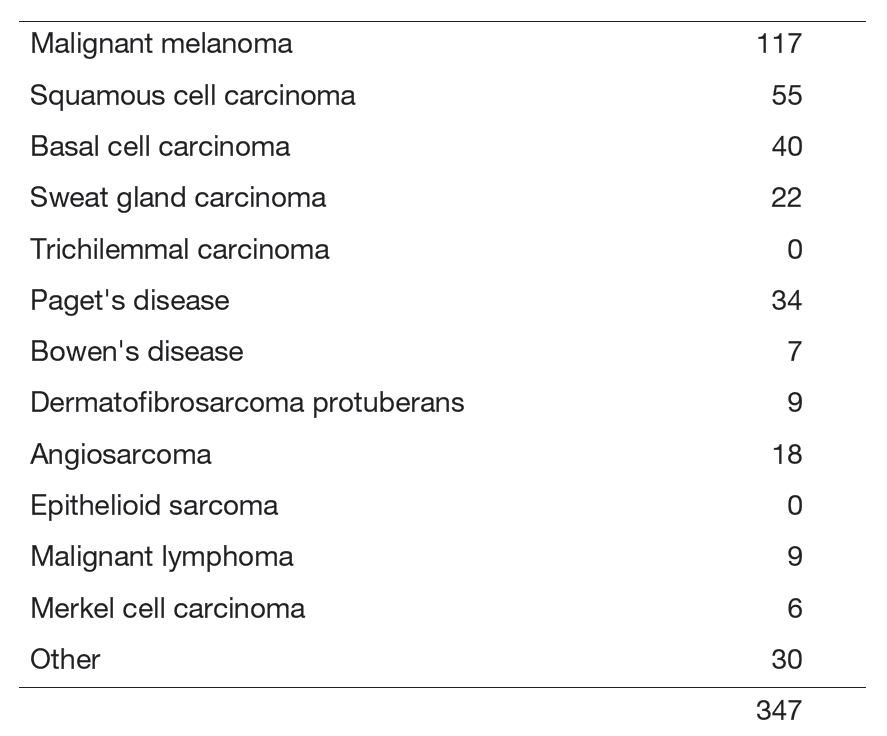
Table 2. Type of procedure (April 2024 to March 2025) 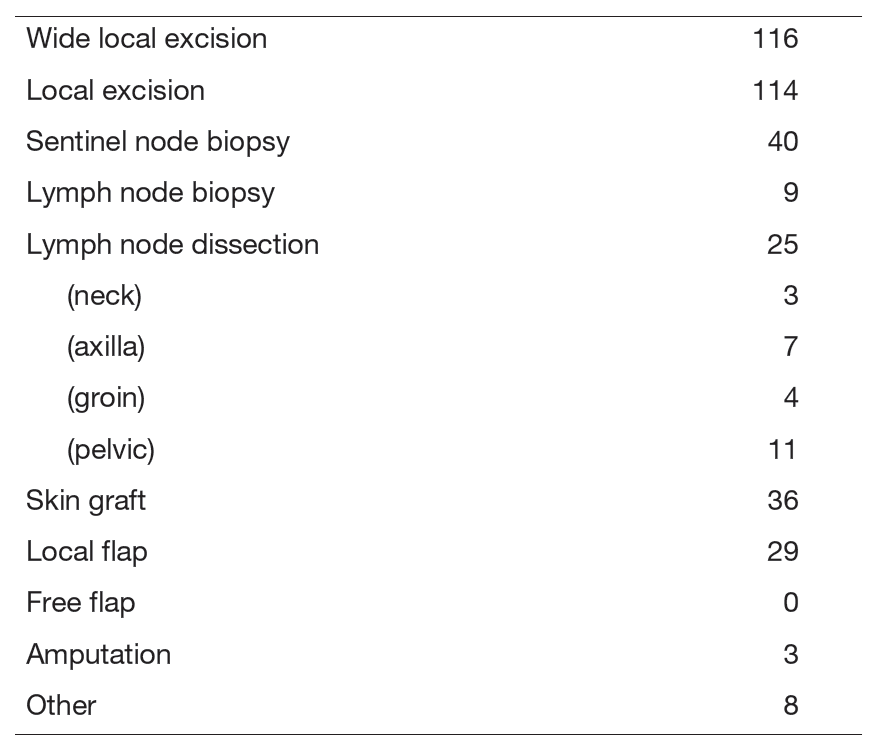
Research Activities
Clinical fellows actively engage in research, frequently presenting and publishing their work as first authors on studies involving various types of skin cancer. Our department also leads and participates in multi-institutional studies, including those organized by the Japan Clinical Oncology Group (JCOG), aiming to establish new standards of care for skin cancers. While melanoma is a rare cancer in Asia, it is common among Caucasians. Consequently, most current treatment strategies have been developed based on trials conducted in Western populations. However, as immune-checkpoint inhibitors have become widely used, it is increasingly evident that biological and immunological differences may exist between ethnicities. This suggests that strategies proven optimal for Caucasian patients may not always be directly applicable to Asian patients. Our department helps to develop Japanese clinical practice guidelines that reflect the characteristics of East Asian patients. In addition, we lead and participate in multiple clinical trials with new drugs, thereby contributing to the advancement of novel therapies (Table 3).
Table 3. Clinical trials with new anti-cancer agents in 2024 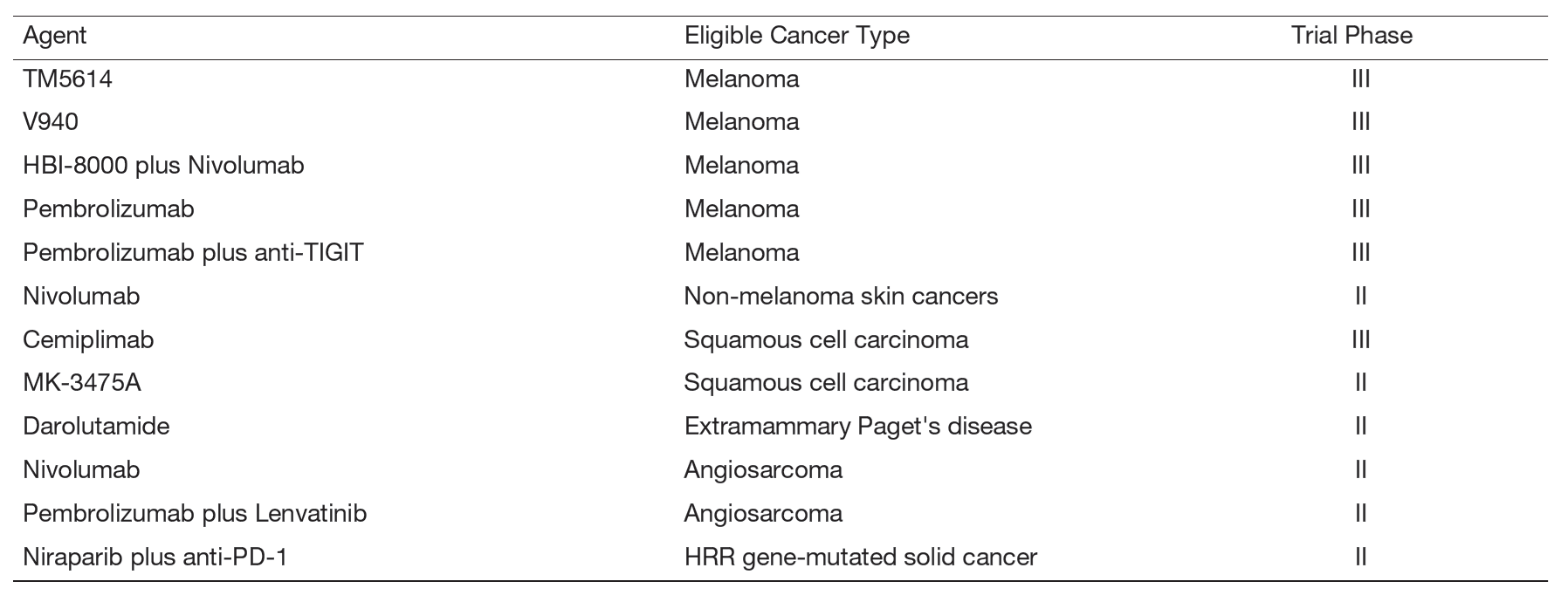
Clinical Trials
- Randomized phase III trial of adjuvant therapy with locoregional interferon beta versus surgery alone in stage II/III cutaneous melanoma (JCOG1309, J-FERON)
- Confirmatory trial of non-amputative digit preservation surgery for subungual melanoma (JCOG1602, J-NAIL)
- A single-arm confirmatory trial of pazopanib in patients with paclitaxel-pretreated primary cutaneous angiosarcoma (JCOG1605, JCOG-PCAS)
- Concordance in judgment of clinical borders of basal cell carcinomas in Japanese patients (JCOG2005, J-BASE-MARGIN)
- Integrated genomic and epigenomic analysis of circulating tumor DNA from patients with malignant melanoma (COSMOS-MEL-01)
- Integrated genomic and epigenomic analysis of circulating tumor DNA from patients with BRAF V600-mutant melanoma (COSMOS-MEL-02)
- A multicenter prospective observational study of a sequential regimen of immune-checkpoint inhibitors and BRAF/MEK inhibitors for advanced BRAF V600-mutant melanoma (B-CHECK-SW)
- The phase II study of pembrolizumab plus lenvatinib for patients with unresectable cutaneous angiosarcoma (NCCH2213, PLAS trial)
Education
We provide close and careful instruction to clinical fellows, not only in the diagnosis and treatment of skin cancers but also in the cultivation of a sincere attitude toward patients with these rare diseases. Weekly conferences are held to review new patients and surgical cases. In addition, we regularly conduct joint conferences with other departments, including the Division of Experimental Therapeutics and the Department of Medical Oncology for drug development, the Department of Pathology for pathological findings, the Department of Radiation Oncology for radiotherapy planning, and the Division of Cancer Immunology at the Research Institute for collaborative research.
Future Prospects
Although skin cancers are classified as rare diseases in Asia, their incidence is increasing with the aging of society. At the same time, only a small number of young dermatologists choose to specialize in skin cancer care, making education and training a pressing issue. The Department of Dermatologic Oncology at the National Cancer Center Hospital will continue to provide high-level, patient-centered care while fostering the next generation of specialists, so that advanced skin cancer treatment can be delivered nationwide. Furthermore, we will actively lead and participate in clinical trials, including international collaborations, to promote the development of new treatments. With a global perspective, we aim to contribute to progress toward the eventual eradication of melanoma and non-melanoma skin cancers.
List of papers published in 2024
Journal
1. Fukuda A, Ogata D, Oshima Y, Nakano E, Namikawa K, Komatsu M, Nakamura A, Sugiura K, Yamazaki N. Grade 3 acute kidney injury caused anti-glomerular basement membrane nephritis during immune checkpoint inhibitor treatment for melanoma. The Journal of dermatology, 52:e168-e169, 2025
2. Kashihara T, Nakamura S, Yamazaki N, Takahashi A, Namikawa K, Ogata D, Nakano E, Okuma K, Kaneda T, Mori T, Ito K, Itami J, Shimada K, Nakagama H, Igaki H. Boron neutron capture therapy for cutaneous angiosarcoma and malignant melanoma: First in-human phase I clinical trial. Radiotherapy and oncology, 202:110607, 2025
3. Wada S, Ishii T, Ogata D, Nakano E, Namikawa K, Yamazaki N, Higashi T. Clinical Features and Prognosis of Malignant Cutaneous Adnexal Tumors: A Retrospective Study Using a Japanese Database. Journal of surgical oncology, 131:1157-1164, 2025
4. Ogata D, Namikawa K, Nakano E, Fujimori M, Uchitomi Y, Higashi T, Satake T, Morizane C, Yamazaki N, Kawai A. Comprehensive epidemiology of melanoma at all sites: insights from Japan's National Cancer Registry, 2016-2017. International journal of clinical oncology, 30:194-198, 2025
5. Schadendorf D, Dummer R, Flaherty KT, Robert C, Arance A, de Groot JWB, Garbe C, Gogas HJ, Gutzmer R, Krajsová I, Liszkay L, Loquai C, Mandalà M, Yamazaki N, Queirolo P, Guenzel C, Polli A, Thakur M, di Pietro A, Ascierto PA. A plain language summary of the 7-year update from part 1 of the COLUMBUS study: encorafenib and binimetinib for people with BRAF V600-mutant melanoma. Future oncology (London, England), 21:523-531, 2025
6. Wada S, Nakano E, Nakajima M, Kishikawa S, Yoshida A, Mori T, Osada A, Ogata D, Namikawa K, Yamazaki N. Congenital dermatofibrosarcoma protuberans on the scalp enlarging and shrinking repeatedly. The Journal of dermatology, 51:e196-e197, 2024
7. Uhara H, Kiyohara Y, Isei T, Nagase K, Kambe A, Sato M, Tanaka Y, Yamazaki N. Safety and effectiveness of avelumab in patients with Merkel cell carcinoma in general clinical practice in Japan: Post-marketing surveillance. The Journal of dermatology, 51:475-483, 2024
8. Kubo T, Sunami K, Koyama T, Kitami M, Fujiwara Y, Kondo S, Yonemori K, Noguchi E, Morizane C, Goto Y, Maejima A, Iwasa S, Hamaguchi T, Kawai A, Namikawa K, Arakawa A, Sugiyama M, Ohno M, Yoshida T, Hiraoka N, Yoshida A, Yoshida M, Nishino T, Furukawa E, Narushima D, Nagai M, Kato M, Ichikawa H, Fujiwara Y, Kohno T, Yamamoto N. The impact of rare cancer and early-line treatments on the benefit of comprehensive genome profiling-based precision oncology. ESMO open, 9:102981, 2024
9. Tsuruta S, Matsuguma K, Kawasaki N, Ishikawa A, Ishiki H. Olanzapine for chemotherapy-induced nausea and vomiting control. The Lancet. Oncology, 25:e176, 2024
10. Nakano E, Takahashi A, Ogata D, Namikawa K, Yamazaki N. Real-world efficacy and safety of BRAF-targeted therapy for patients with advanced melanoma: A single-center retrospective study in Japan. The Journal of dermatology, 51:1199-1207, 2024
11. Schadendorf D, Dummer R, Flaherty KT, Robert C, Arance A, de Groot JWB, Garbe C, Gogas HJ, Gutzmer R, Krajsová I, Liszkay G, Loquai C, Mandalà M, Yamazaki N, Queirolo P, Guenzel C, Polli A, Thakur M, di Pietro A, Ascierto PA. COLUMBUS 7-year update: A randomized, open-label, phase III trial of encorafenib plus binimetinib versus vemurafenib or encorafenib in patients with BRAF V600E/K-mutant melanoma. European journal of cancer (Oxford, England : 1990), 204:114073, 2024
12. Muto Y, Fujimura T, Takahashi A, Namikawa K, Ogata D, Nakano E, Jinnai S, Hashimoto A, Kambayashi Y, Asano Y, Yamazaki N. Analysis of surgical margins and prognostic factors in dermatofibrosarcoma protuberans after wide local excision: A multicenter study of 116 Japanese patients. The Journal of dermatology, 51:1225-1232, 2024
13. Tanese K, Ogata D. The role of macrophage migration inhibitory factor family and CD74 in the pathogenesis of melanoma. Experimental dermatology, 33:e15122, 2024
14. Hashimoto T, Nakamura Y, Fujisawa T, Imai M, Shibuki T, Iida N, Ozaki H, Nonomura N, Morizane C, Iwata H, Okano S, Yamagami W, Yamazaki N, Kadowaki S, Taniguchi H, Ueno M, Boku S, Oki E, Komatsu Y, Yuki S, Makiyama A, Otsuka T, Hara H, Okano N, Nishina T, Sakamoto Y, Miki I, Kobayashi S, Yuda J, Kageyama SI, Nagamine M, Sakashita S, Sakamoto N, Yamashita R, Koga Y, Bando H, Ishii G, Kuwata T, Park WY, Ohtsu A, Yoshino T. The SCRUM-MONSTAR Cancer-Omics Ecosystem: Striving for a Quantum Leap in Precision Medicine. Cancer discovery, 14:2243-2261, 2024
15. Tsuruta S, Ogata D, Namikawa K, Nakano E, Yamazaki N. A review of cutaneous apocrine carcinoma: epidemiology, diagnosis, prognosis, and treatment options. Japanese journal of clinical oncology, 54:1135-1140, 2024