

Annual Report 2024
Department of Anesthesiology and Intensive Care Medicine
Tetsufumi Sato, Junya Matsumi, Akiko Ohgaku, Yousuke Kawaguchi, Yuri Ohishi, Misako Shigematsu, Naohiro Shioji, Sakiko Sasaki, Yutaro Asagoe, Yuki Enomoto, Hiroaki Takahashi, Yumi Saito, Yo Higuchi, Yuko Sakurai, Erina Hara, Ai Asatsuma, Tomoko Egawa, Sumire Iwasa
Introduction
The Department of Anesthesiology and Intensive Care Medicine provides anesthesia and intensive care. Over 5,000 cases of anesthetic services are provided annually at 15 main operation rooms, 1 MRI operation room, and 1 radioisotope operation room. Over 1,000 cases of intensive care are provided annually at 8 beds. Our intensivists are also responsible for advising on the management of critically ill patients at wards and on resuscitation.
The Team and What We Do
We provide perioperative care to all patients who require general anesthesia and spinal analgesia. Our operating section performs approximately 5,000 anesthetics annually, including general anesthesia with or without epidural anesthesia, spinal anesthesia, and monitored anesthetic care (Table 1). In addition, scheduled surgery patients receive care by the perioperative management center, including the Anesthesia Consult Clinic.
Table 1. Number of anesthesia cases, classified by anesthetic methods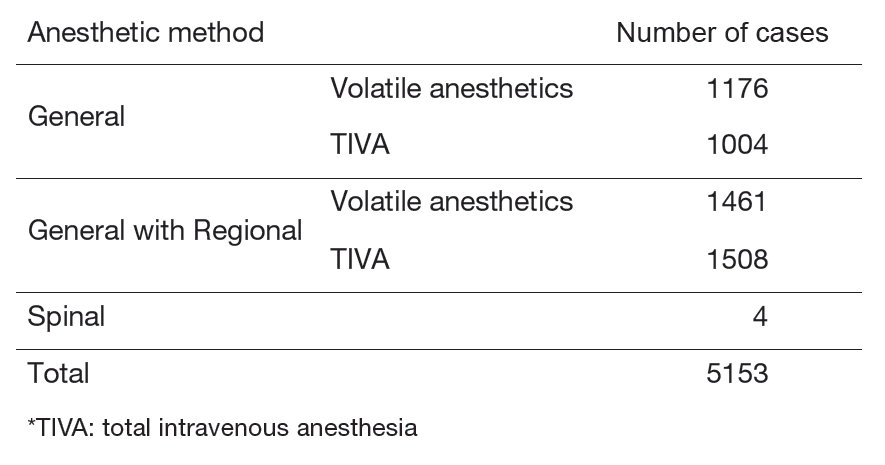
Furthermore, our intensive care unit is certificated by the Japanese Society of Intensive Care Medicine and operates as a closed system, overseen by some of our staff, including 6 certificated intensivists. Around 1,100 cases of intensive care are provided annually at 8 beds. Most of the patients treated in the intensive care units have post-surgical indications, although some are treated for medical emergencies.
Table 2. Number of patients managed at intensive care unit, classified by clinical department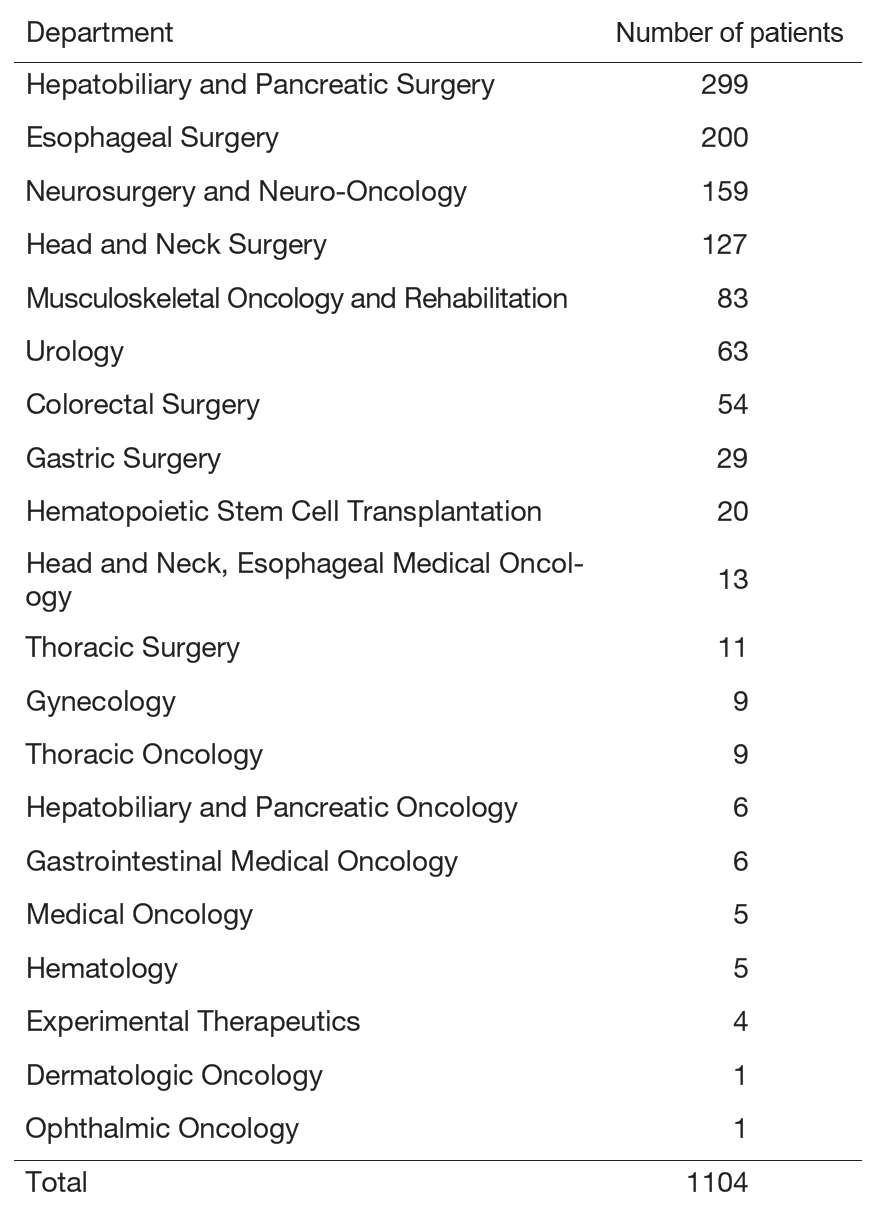
Some members of our department are actively involved in clinical research and supervise postdoctoral, doctoral, postgraduate and undergraduate students.
Research Activities
We analyzed the impacts of perioperative team management and anesthesia management on postoperative outcomes, as well as the medium- to long-term prognosis and prognostic factors of cancer survivors who required intensive care due to deterioration of their condition. We are actively conducting studies aimed at enhancing the current care provided to perioperative and critically ill cancer patients.
Education
For clinical training of non-certified anesthesiologists, their anesthetic management is supervised by certified anesthesiologists. For clinical training of non-certified intensivists, their critical care is supervised by certified intensivists. We also offer guidance for academic conference presentations and the preparation of scientific papers. These are not only for their clinical experiences, but also for qualifying as certified specialists.
Future Prospects
We will continue our effort to achieve more effective perioperative care, including anesthesia and critical care for cancer patients. We will also improve perioperative management through initiatives like cross-departmental collaboration and multi-disciplinary teams, aimed at ensuring the safety of the patients.