

Annual Report 2024
Department of Genetic Medicine and Services
Makoto Hirata, Teruhiko Yoshida, Kokichi Sugano, Fumito Yamazaki, Ayaka Sato, Mizuki Watanabe, Shigenobu Suzuki, Mitsuya Ishikawa, Nobuyoshi Hiraoka, Shigeki Sekine, Taisuke Mori, Kuniko Sunami, Noboru Yamamoto, Takahisa Matsuda, Hiromi Sakamoto, Mineko Ushiama, Akane Sei, Takashi Kohno, Mamoru Kato, Hitoshi Ichikawa, Satoyo Oda, Manami Matsukawa, Chikako Tomozawa, Noriko Tanabe, Tomoko Watanabe
Introduction
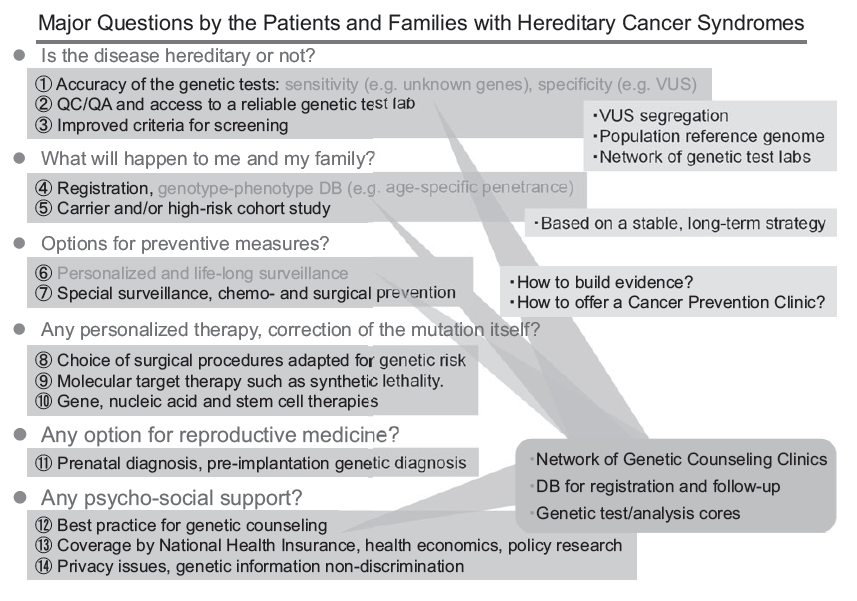
It has been estimated that roughly 5% of all cancer cases are caused by a highly penetrant monogenic mutation. The major causative genes for most hereditary cancer syndromes were identified in the 1990s. Since then, genetic diagnosis has been considered as a part of standard medical care in oncology clinics. The National Cancer Center Hospital (NCCH) launched the Outpatient Genetic Counseling Clinic in 1998 as part of a collaboration with the NCC Research Institute, specifically the Fundamental Innovative Oncology Core (FIOC). However, several issues remain to be addressed in cancer medical genetics, as shown in Figure 1.
The Team and What We Do
The Department of Genetic Medicine and Services (GeMS) comprises doctors, researchers, and genetic counselors. Most of these staff hold a concurrent post of another department and research division, except the genetic counselors.
As shown on the NCCH website, the aim and mission of the clinical service of the Outpatient Genetic Counseling Clinic, which are the major routine clinical activities of our department, are:
1) To provide consultation and appropriate medical and genetic information (that is, genetic counseling) to anyone who has a concern related to hereditary cancer.
2) To provide genetic testing when appropriate.
3) To support early diagnosis and treatment based on family history and/or genetic test results.
4) To discuss the clinical sequencing results of patients by participating in the Expert panel.
For the period from April 2024 to March 2025, 357 clients and their relatives visited the clinic. Of these, 159 families and 189 clients newly visited during this period. In total, 2,680 families have visited the clinic since its inception in 1998. Details are shown in Table 1.
Table 1. Number of new clients (Apr. 2024 – Mar. 2025)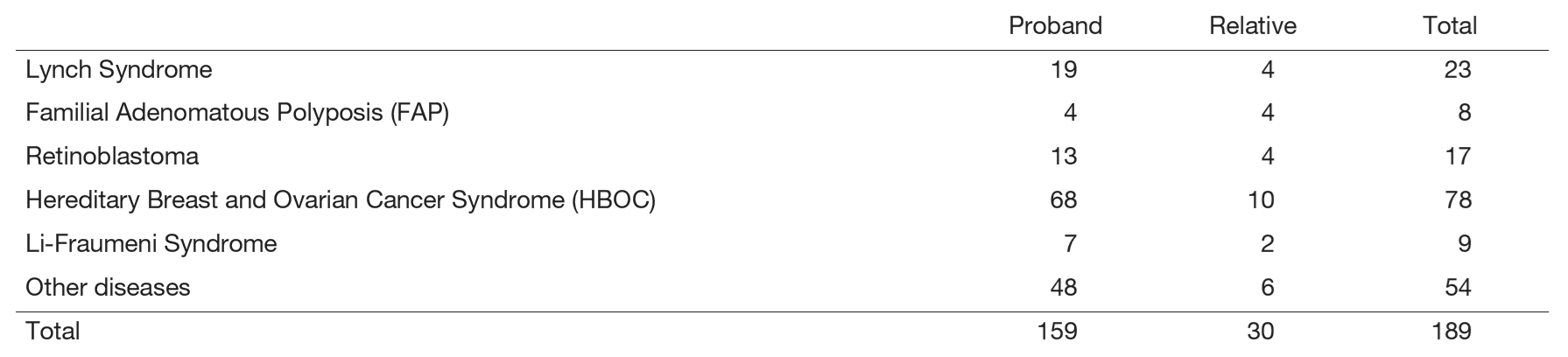
Research Activities
Although at least one causative gene has been identified for each of the major hereditary cancer syndromes, overall sensitivity of the current genetic tests is far from 100% and may be around 70-80%, even for the cases that meet clinical and/or screening criteria for hereditary cancer syndromes. The false negative cases may include both inadequate technical sensitivity of the current genetic test methods on the established causative genes (allelic heterogeneity) and also yet-to-be-identified genes representing locus heterogeneity. There has been great expectation that the introduction of next generation sequencers (NGS) would change the situation. The staff of the Department of GeMS have established a new Universal Protocol to perform NGS-based germline whole genome and multi-gene panel sequencing for patients with negative test results by conventional genetic tests, who would represent a part of the Undiagnosed Disease Patients in the oncology field. The Universal Protocol has been adopted by other hospitals and institutions in a long-standing multi-institutional collaborative research group based on the National Cancer Center Research and Development Fund and its predecessor.
Clinical Trials
We have participated in an expert panel of clinical sequencing conducted by health insurance systems since May 29, 2019. In addition, we have participated in the TOP2 panel of the Japanese Children's Cancer Study Group (JCCG), which have been conducted as research. Based on the Action Plan for Whole Genome Analysis 2022, we also promoted clinical research on whole genome and transcriptome analyses by obtaining informed consent, disclosing their results, evaluating genomic findings, and creating supportive animations for IC.
Education
The Department has accepted attendees for outpatient genetic counseling, making them eligible to take the examination for clinical geneticists and certified genetic counselors, as recognized by the Japan Society of Human Genetics and the Japanese Society of Genetic Counseling and/or Hereditary Cancer Specialists, acknowledged by the Japanese Society for Hereditary Tumors. In FY2024, one doctor who registered as a trainee for clinical geneticists passed the exam. As for Hereditary Tumor Specialists, five doctors registered as trainees, and one of them, after obtaining eligibility, passed the exam. We accepted five residents in FY2024. In addition, we accepted three visitors: one resident and one certified genetic counselor from other hospitals, and one medical student from another university.
Future Prospects
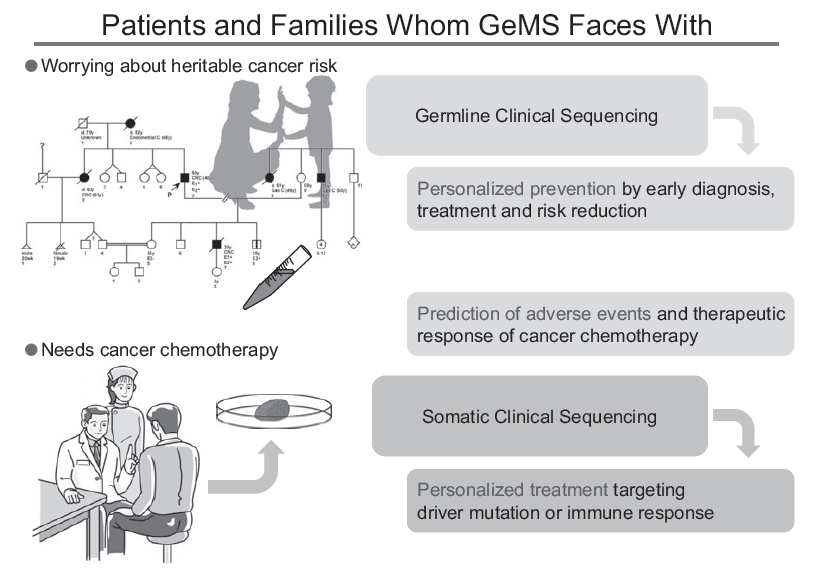
The Department of GeMS was launched in November 2015. Although this section reports on the routine clinical activity of the Department and clinical research associated directly with the Outpatient Genetic Counseling Clinic, the scope and mission of the Department extend beyond hereditary cancer syndromes and include support of the genomic biomarker-driven personalized cancer treatments offered by other clinical departments (Fig. 2). The core technology of the new discipline, also known as a precision medicine, is next-generation sequencers, which would bring massive amounts of genomic data to cancer diagnosis, treatment and prevention. The crux of this emerging opportunity is how to convert the sequence data to clinically valid and useful knowledge, which could include incidental or secondary findings. The Department of GeMS is expected to support other departments in the era of genomic medicine.
List of papers published in 2024
Journal
1. Tomozawa C, Kaneko M, Sasaki M, Miyake H. Clients' experiences of empathy in genetic counseling for hereditary breast and ovarian cancer: A qualitative study in Japan. Journal of genetic counseling, 34:e1920, 2025
2. Fujii H, Okuma Y, Hirata M, Shinno Y, Yoshida T, Goto Y, Horinouchi H, Yamamoto N, Ohe Y. EGFR-Mutated Lung Adenocarcinoma With Li-Fraumeni Syndrome: The Imperative for Germline Testing in Patients With a Family History, a Case Report. JTO clinical and research reports, 6:100691, 2025
3. Koizumi S, Iwaizumi M, Baba S, Ushiama M, Hirata M, Kurozumi K. Genomic analysis revealing Lynch syndrome in a case of high-grade glioma: illustrative case. Journal of neurosurgery. Case lessons, 9:CASE24718, 2025
4. Matsukawa M, Tomozawa C, Nakamura Y, Fujisawa T, Kimura K, Hiraoka Y, Yamashita R, Kosugi S, Sakurai A, Imoto I, Nishigaki M, Hirata M, Kuwata T, Yoshino T. Establishment of a comprehensive set of fact sheets for cancer predisposition genes for medical oncologists practicing cancer genome profiling. International journal of clinical oncology, 30:827-836, 2025
5. Matsui H, Hirata M. Evaluation of the pathogenic potential of germline DDX41 variants in hematopoietic neoplasms using the ACMG/AMP guidelines. International journal of hematology, 119:552-563, 2024
6. Kobayashi Y, Nakamura Y, Tahara U, Nakamura K, Nakanishi K, Miyagawa A, Horikawa H, Kobayashi K, Funakoshi T, Sugano K, Ushiama M, Yoshida T, Inazumi T. Identification of a rare MET variant in three siblings with extramammary Paget disease. Clinical and experimental dermatology, 49:882-886, 2024
7. Fukuda H, Arai K, Mizuno H, Nishito Y, Motoi N, Arai Y, Hiraoka N, Shibata T, Sonobe Y, Kayukawa Y, Hashimoto E, Takahashi M, Fujii E, Maruyama T, Kuwabara K, Nishizawa T, Mizoguchi Y, Yoshida Y, Watanabe SI, Yamashita M, Kitano S, Sakamoto H, Nagata Y, Mitsumori R, Ozaki K, Niida S, Kanai Y, Hirayama A, Soga T, Tsukada K, Yabuki N, Shimada M, Kitazawa T, Natori O, Sawada N, Kato A, Yoshida T, Yasuda K, Ochiai A, Tsunoda H, Aoki K. Molecular subtypes of lung adenocarcinoma present distinct immune tumor microenvironments. Cancer science, 115:1763-1777, 2024
8. Takamizawa S, Koyama T, Sunami K, Sudo K, Hirata M, Kubo T, Tao K, Cho H, Narita Y, Kato K, Yamazaki N, Ohe Y, Okusaka T, Matsui Y, Ogawa C, Yonemori K, Yamamoto N. Identification of barriers to implementation of precision oncology in patients with rare cancers. Cancer science, 115:2023-2035, 2024
9. Ishida A, Inokuchi Y, Hirata M, Narimatsu H, Yoshioka E, Washimi K, Machida N, Maeda S. A case of an unreported point mutation in promoter 1B of the adenomatous polyposis coli gene, which is responsible for gastric adenocarcinoma and proximal polyposis of the stomach. Clinical journal of gastroenterology, 17:602-606, 2024
10. Nakahara M, Ushiama M, Tanabe N, Gotoh M, Sakamoto H, Yoshida T, Hirata M. Multi-gene panel analysis in BRCA1/2-negative patients suspected of hereditary breast and ovarian cancer syndrome: Real-world data from a single institution. The journal of obstetrics and gynaecology research, 50:1591-1597, 2024
11. Suzuki Y, Iemura R, Sutani A, Mizuno Y, Adachi E, Ushiama M, Yoshida T, Hirata M, Hoshino A, Yamomoto K, Akashi T, Nakano Y, Isoda T, Takasawa K, Kato M, Takagi M, Okamoto K, Morio T, Kashimada K. Familial and early recurrent pheochromocytoma in a child with a novel in-frame duplication variant of VHL. Clinical pediatric endocrinology, 33:229-237, 2024