

Annual Report 2024
Central Radioisotope Division
Masamichi Ishiai, Akihiro Yanagihara, Hiroshi Tanooka, Mitsuko Masutani, Makoto Ihara, Ying Tong, Takahiro Hamoya, Gen Fujii, Airi Nakano, Natsuki Kondo, Hideyuki Watanuma
Introduction
The Central Radioisotope Division is a joint usage facility composed of the Research Support Core of the Fundamental Innovative Oncology Core (FIOC) of the National Cancer Center (NCC) Research Institute. We provide advanced technical training and education for researchers in the NCC. We also support and advise on radiation-related cancer research.
The Team and What We Do
Our division manages radioisotope (RI) materials, gamma-ray irradiators (Gammacell 220 with Co-60 source and Gammacell 40 Exactor with Cs-137 source), and radiation-related equipment to promote advanced cancer research in a smooth manner. Our division also conducts radiation management studies so that researchers can use RI resources safely and effectively.
Research Activities
We have been conducting research on cancer risk after irradiation by several approaches. First, we have focused on the study of molecular mechanisms of cellular responses such as DNA damage signaling, and DNA repair pathways after DNA damage, including by irradiation. Second, we have developed a radiotherapy model by mouse. Third, through collaboration with the Department of Radiation Oncology of the NCC Hospital and industry, we conducted preclinical research as well as basic and translational studies of the biological effects by accelerator-based neutron irradiation, and boron capture therapy (BNCT) system introduced in the NCC. Forth, we have conducted basic research on alpha-emitting nuclides for biological/medical use. Fifth, we have also investigated the molecular mechanisms of cancer chemoprevention. The research topics were presented at international and domestic conferences and published.
Facility Utilization Information
The usage frequency of gamma-ray irradiators and used amounts of RI for the past five years are shown in Tables 1 and 2, respectively.
Table 1. Number of uses for gamma-ray irradiator 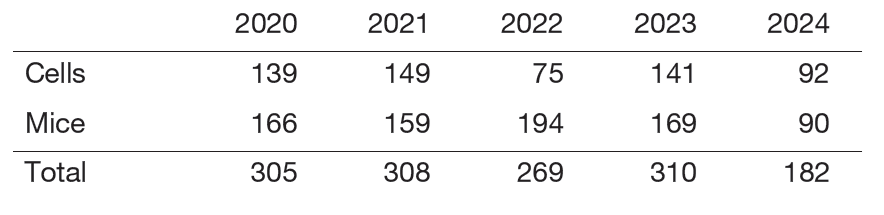
Table 2. Used amounts of radioisotopes (MBq)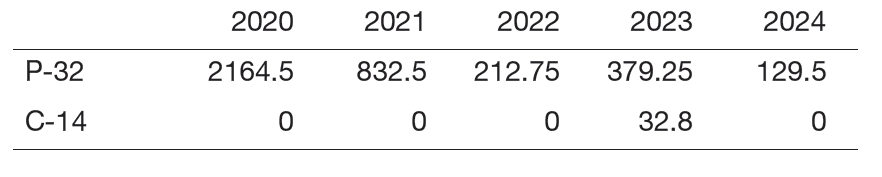
Education
We provide an annual course of education and training in radiation biology, handling of RI, and operating of gamma-ray irradiators.
Two graduate students were trained in our division.
Future Prospects
A clinical trial for cancer patients using BNCT has been initiated in the NCC Hospital, so opportunities to handle neutron-irradiated cells have increased in our division. In addition, we have started preparations for theranostics research.
List of papers published in 2024
Journal
1. Imamichi S, Ito T, Tong Y, Gao Z, Arai Y, Fujimori H, Chen L, Sanada Y, Nakamura S, Murakami Y, Ishiai M, Suzuki M, Itami J, Igaki H, Masunaga S, Masutani M. Transcriptome analysis of human oral squamous cancer SAS cells as an early response after boron neutron capture therapy. Applied radiation and isotopes : including data, instrumentation and methods for use in agriculture, industry and medicine, 218:111648, 2025
2. Tsukada K, Imamura R, Miyake T, Saikawa K, Saito M, Kase N, Fu L, Ishiai M, Matsumoto Y, Shimada M. CDK-mediated phosphorylation of PNKP is required for end-processing of single-strand DNA gaps on Okazaki fragments and genome stability. eLife, 14:e99217, 2025