
Home > Organization > Divisions and Independent Research Units > Division of Cancer Therapeutics > Research Projects
Research Projects
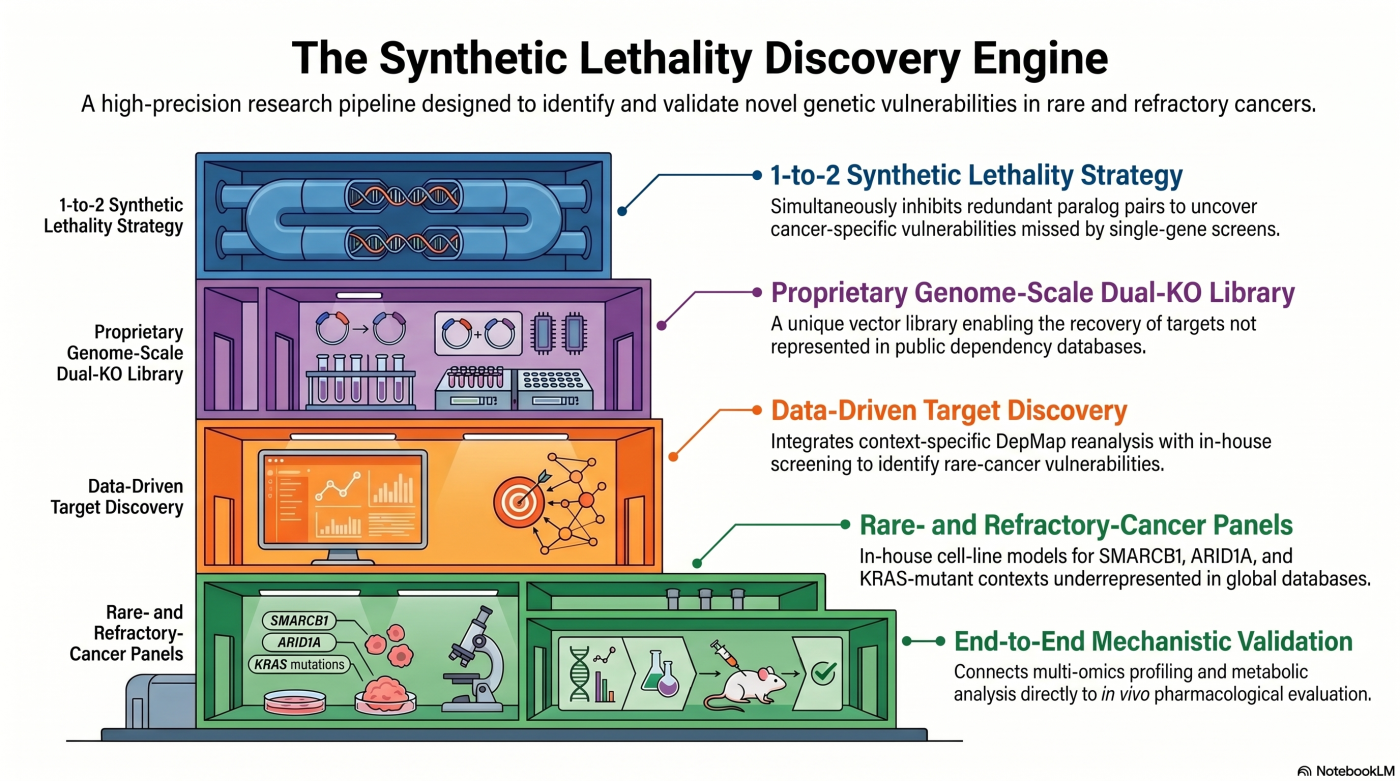
Our laboratory integrates target identification, mechanistic dissection, compound evaluation, and early drug-discovery validation within a single end-to-end pipeline. This page is structured in three parts: (1) the four research foundations that drive our discovery work; (2) the disease-focused programs in which those foundations are applied; and (3) partnership opportunities for industry and academic collaborators.
(Figure placeholder — replace with figure or remove before publication)
Our Research Foundations
Four integrated research foundations support our discovery pipeline, from target identification through mechanistic analysis and pharmacological evaluation.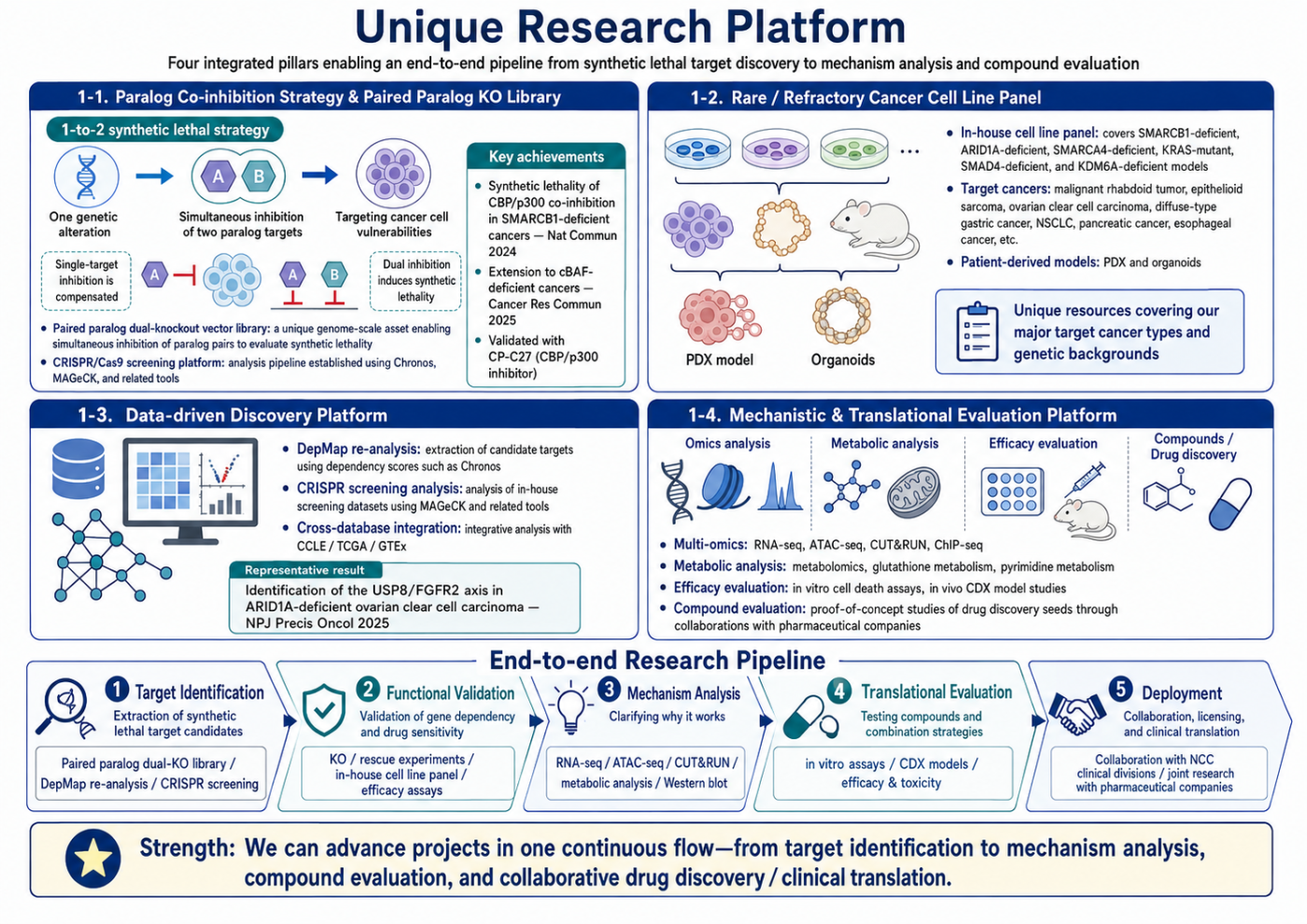
Foundation 1 — Paralog Co-Inhibition Strategy and Paralog-Pair Dual-KO Library
1-to-2 Synthetic Lethality Strategy
Approximately one-third of human genes have functional paralogs — duplicated genes whose redundancy buffers the loss of any single member. Conventional synthetic-lethality screens focus on the two-factor relationship ("inhibit gene B, given that gene A is lost in cancer"); against paralog-buffered targets, single-gene inhibition often fails because the redundant paralog compensates.
We pioneered the paralog co-inhibition strategy — a 1-to-2 synthetic-lethality framework that simultaneously inhibits both members of a paralog pair that would otherwise buffer each other (Sasaki et al., Nat Commun 2024). Starting from a gene lost in cancer (factor 1), simultaneous inhibition of the paralog pair (factors 2 and 3) aims to exploit vulnerabilities specific to cancer cells carrying the relevant genetic alteration. This extends the conventional two-factor framework to a three-factor relationship and forms the conceptual basis for the higher-order frameworks described in Research Highlights Theme 3.
Assets underlying the strategy:
- Proprietary genome-scale paralog-pair dual-knockout vector library — not represented in public dependency databases. Enables recovery of paralog-buffered synthetic-lethal targets that single-gene screens systematically miss.
- CRISPR/Cas9 screening pipeline — in-house screen design and downstream analysis optimized for rare- and refractory-cancer cell lines.
Validated results (within published scope):
- CBP/p300 dual inhibition is synthetic-lethal in SMARCB1-deficient cancers (malignant rhabdoid tumor, epithelioid sarcoma) — Nat Commun 2024 (Sasaki et al.)
- Extension to cBAF-deficient cancers (SMARCA4-deficient lung cancer, synovial sarcoma) — Cancer Res Commun 2025 (Sasaki et al.)
- Research-use compound CP-C27 (dual CBP/p300 inhibitor) used for in vivo validation — Nat Commun 2024
→ Thematic deep dive: Research Highlights — Paralog Co-Inhibition
Foundation 2 — Rare- and Refractory-Cancer Cell-Line Panels
In-House Disease Models Covering Japan-Specific and Rare Cancer Contexts
Our in-house cell-line panels represent the genetic backgrounds central to our research programs:
- SMARCB1-deficient models (malignant rhabdoid tumor, epithelioid sarcoma)
- ARID1A-deficient models (ovarian clear cell carcinoma, diffuse-type gastric cancer)
- SMARCA4-deficient models (non-small cell lung cancer)
- KRAS-mutant models (lung cancer: G12C; pancreatic cancer: G12D, G12V)
- SMAD4-deficient models (diffuse gastric cancer, pancreatic cancer, esophageal cancer)
- KDM6A-deficient models (esophageal cancer)
- PBRM1-deficient models (renal cell carcinoma)
The panel includes patient-derived cell lines for gastric and pancreatic cancers, and comprehensive panels spanning lung cancer, sarcoma, esophageal cancer, and renal cancer — covering cancer types and molecular subtypes underrepresented in international public databases such as DepMap. These assets support disease-relevant validation where public dependency databases alone are insufficient.
→ Applied in all six disease programs and in DepMap-orthogonal validation workflows.
Foundation 3 — Data-Driven Target Discovery
DepMap Reanalysis Integrated with In-House CRISPR/Cas9 Screening
Public cancer dependency datasets contain informative signals that are obscured by pan-cancer averaging. We apply three analytical layers to extract rare-cancer-specific vulnerabilities:
- Context-specific re-analysis — restricted to a single cancer lineage with molecular subgroup stratification (e.g., ARID1A-deficient vs. intact ovarian clear cell carcinoma)
- Integration with in-house cell lines — orthogonal validation in cell lines absent from DepMap, including Japan-specific and rare cancer subtypes
- Pathway-level interpretation — accounting for paralog-mediated redundancy that can suppress dependency signals in public data
In practice, we validate candidate dependencies from DepMap re-analysis by CRISPR/Cas9 screening in our in-house cell-line panels, comparing results against Chronos-based DepMap gene-effect scores.
Representative result:
- USP8 identified as a synthetic-lethal target in ARID1A-deficient ovarian clear cell carcinoma — NPJ Precis Oncol 2025 (Saito et al.)
→ Thematic deep dive: Research Highlights — Data-Driven Target Discovery
Foundation 4 — Mechanistic and Pharmacological Validation
Multi-Omics Mechanistic Analysis Connected to In Vitro and In Vivo Evaluation
Following target identification, we dissect the mechanism by which a vulnerability exists and validate its pharmacological tractability through:
- Multi-omics profiling — RNA-seq, ATAC-seq, CUT&RUN, and ChIP-seq for chromatin-level mechanistic dissection
- Metabolic analysis — metabolomics, glutathione metabolism, and pyrimidine-metabolism pathway analysis
- Pharmacological evaluation — in vitro cell-death assays across our cell-line panels; in vivo evaluation in cell-line-derived xenograft (CDX) models
- Compound evaluation — validation of research-use compounds and, where applicable, collaborative evaluation with industry partners
End-to-End Discovery Pipeline
The four foundations above are connected as a single, self-contained pipeline spanning five phases:
|
Phase |
Content |
Key Technologies and Assets |
|---|---|---|
|
Target Identification |
Extraction of synthetic-lethal target candidates |
Paralog-pair dual-KO library, DepMap reanalysis, CRISPR/Cas9 screening |
|
Functional Validation |
Confirmation of gene dependency and compound sensitivity |
KO / rescue experiments, in-house cell-line panels, pharmacological evaluation |
|
Mechanistic Analysis |
Resolving why the vulnerability exists |
RNA-seq, ATAC-seq, CUT&RUN, metabolomics, western blot |
|
Pharmacological Evaluation |
Validation of compounds and combination strategies |
In vitro evaluation, CDX models, antitumor efficacy and tolerability-related readouts |
|
Translation and Development |
Industry collaboration, drug-discovery seed development |
NCC clinical departments, pharmaceutical industry partners |
This integrated structure enables rapid iteration from hypothesis generation to experimental validation.
Disease-Focused Programs

We apply the four foundations above to cancers in which a defined genetic vulnerability is present but molecularly targeted treatment options remain limited. Our programs are organized in two categories.
Note: Mutation frequencies cited here reflect literature values; full citations are available on the Publications page and Research Highlights.
Category A — Rare, Pediatric, and AYA Cancers
Project A-1: SMARCB1-Deficient Rare Cancers — Malignant Rhabdoid Tumor and Epithelioid Sarcoma
|
Item |
Detail |
|---|---|
|
Driver alteration |
SMARCB1 loss — present in the large majority of malignant rhabdoid tumor cases; also the major molecular alteration in epithelioid sarcoma |
|
Patient population |
Pediatric (malignant rhabdoid tumor) and AYA (adolescent and young adult; epithelioid sarcoma) |
|
Clinical challenge |
Aggressive clinical course with poor prognosis; limited molecularly targeted treatment options |
|
Our approach |
(1) Paralog co-inhibition: CBP/p300 dual inhibition established as a synthetic-lethal strategy; (2) Metabolic vulnerability: GCLC inhibition triggering ferroptosis via glutathione pathway fragility |
|
Key publications |
Sasaki et al., Nat Commun 2024 — paralog co-inhibition, CP-C27 validation; Takeuchi et al., Cancer Res 2026 — GCLC inhibitors, in collaboration with Ono Pharmaceutical Co., Ltd. |
|
Related Highlights |
Project A-2: ARID1A-Deficient Ovarian Clear Cell Carcinoma
|
Item |
Detail |
|---|---|
|
Driver alteration |
ARID1A loss (~50% of cases) |
|
Patient population |
Histological subtype with relatively higher prevalence in Japanese women |
|
Clinical challenge |
Poor response to platinum-based chemotherapy; limited treatment options at recurrence |
|
Our approach |
Three parallel strategies: (1) glutathione metabolic vulnerability; (2) data-driven identification of USP8/FGFR2 synthetic lethality; (3) biomarker-defined repositioning of gemcitabine |
|
Key publications |
Ogiwara et al., Cancer Cell 2019 — glutathione metabolic dependency; Kuroda et al., Gynecol Oncol 2019 — gemcitabine selective efficacy (n=149 retrospective cohort); Saito et al., NPJ Precis Oncol 2025 — USP8 synthetic lethality |
|
Related Highlights |
Glutathione Metabolic Vulnerability / Drug Repositioning / Data-Driven Target Discovery |
Category B — Refractory Solid Tumors
Project B-1: Non-Small Cell Lung Cancer (NSCLC)
|
Item |
Detail |
|---|---|
|
Driver alterations |
SMARCA4 loss (~10%) / CREBBP mutation (~8%) / SMARCA4+SMARCA2 dual loss (subset) / KRAS mutation |
|
Clinical challenge |
Includes patients lacking representative actionable driver alterations such as EGFR mutations or ALK fusions; dual SMARCA4/SMARCA2 loss represents a subgroup for which existing SMARCA2-targeting strategies are inapplicable |
|
Our approach |
(1) 1-to-1 SL: SMARCA2 dependency in SMARCA4-deficient NSCLC; EP300 dependency in CREBBP-deficient cancers; (2) Higher-order SL: CHD3 dependency in dual SMARCA4/SMARCA2-deficient lung adenocarcinoma (2-to-1 framework); (3) KRAS-mutant NSCLC is additionally being evaluated as a context for identifying synthetic-lethal vulnerabilities associated with SWI/SNF alterations and drug-resistance mechanisms |
|
Key publications |
Oike et al., Cancer Res 2013 — SMARCA2 dependency; Ogiwara et al., Cancer Discov 2016 — EP300 dependency; Takeuchi et al., NPJ Precis Oncol 2026 (in press) — CHD3/Next-Gen SL in dual SMARCA4/SMARCA2-deficient NSCLC; Kanada et al., J Med Chem 2023 — EP300/CBP HAT inhibitor DS-9300 |
|
Related Highlights |
Conventional Synthetic Lethality / Paralog Co-Inhibition / Next-Generation Synthetic Lethality |
Project B-2: Diffuse-Type Gastric Cancer (Including Scirrhous Gastric Cancer)
|
Item |
Detail |
|---|---|
|
Driver alterations |
ARID1A loss (~25%) / SMAD4 loss |
|
Clinical challenge |
High propensity for peritoneal dissemination; limited efficacy of standard 5-FU-based chemotherapy in a subset of patients with aggressive disease |
|
Our approach |
In-house cell-line screening identified a pyrimidine-metabolism vulnerability: ARID1A loss creates a metabolic bottleneck in the dCTP pool via SLC28A3 silencing, enabling a gemcitabine dual-hit mechanism |
|
Key publications |
Hirano et al., Mol Cancer Res 2026 — pyrimidine metabolic vulnerability and gemcitabine dual-hit mechanism; validation in peritoneal-dissemination CDX model |
|
Related Highlights |
Project B-3: Pancreatic Cancer and Esophageal Cancer
These programs are grouped as exploratory efforts centered on recurrent loss-of-function alterations and resistance-associated genetic contexts rather than a single histology.
|
Item |
Detail |
|---|---|
|
Driver alterations |
SMAD4 loss (~33% in pancreatic cancer; subset in esophageal) / KRAS mutation (~95% in pancreatic) / KDM6A loss (~14% in esophageal) |
|
Clinical challenge |
Despite emerging KRAS-targeted therapies, clinical outcomes remain poor in many advanced cases; multi-pronged therapeutic strategies are needed |
|
Our approach |
Targeting epigenetic regulators (KDM6A) and metabolic pathways to identify vulnerabilities that may overcome resistance to standard treatment; exploration of synthetic-lethal interactions on the SMAD4 / KDM6A / KRAS axis |
|
Status |
Target-discovery programs in progress; this section will be updated as findings are published |
|
Related Highlights |
Data-Driven Target Discovery / Next-Generation Synthetic Lethality |
Project B-4: PBRM1-Deficient Renal Cell Carcinoma
|
Item |
Detail |
|---|---|
|
Driver alteration |
PBRM1 loss |
|
Clinical challenge |
Diverse responses to existing targeted and immunotherapeutic approaches; molecular-subgroup-based stratification and new therapeutic target identification are needed |
|
Our approach |
Exploration of synthetic-lethal targets associated with SWI/SNF chromatin remodeling complex deficiency; building on the glutathione vulnerability framework established for related SWI/SNF-deficient cancers |
|
Status |
Exploratory phase, building on findings from Sasaki et al., Sci Rep 2024 and the broader SWI/SNF vulnerability program |
|
Related Highlights |
Glutathione Metabolic Vulnerability / Data-Driven Target Discovery |
For Industry and Academic Partners
We actively pursue collaborations with pharmaceutical and academic partners, anchored in mechanism-driven target identification and a track record disclosed in peer-reviewed publications.
Our platform assets available for collaboration:
- A proprietary paralog-pair dual-knockout library — not represented in public dependency databases; enables recovery of paralog-buffered targets that single-gene screens cannot access.
- In-house rare- and refractory-cancer cell-line panels — including patient-derived cell lines for gastric and pancreatic cancers, and comprehensive panels spanning lung cancer, sarcoma, esophageal cancer, and renal cancer; covering cancer types and molecular subtypes underrepresented in international public databases.
- End-to-end mechanistic and pharmacological evaluation — from target identification, through mechanistic dissection, to pharmacological validation and indication-expansion analysis.
Published track record of industry collaboration:
The following is disclosed in the corresponding peer-reviewed publication:
- Ono Pharmaceutical Co., Ltd. × Division of Cancer Therapeutics — GCLC inhibitor program (GCLCi1 / GCLCi0) in SMARCB1-deficient rare cancers — Cancer Res 2026 (Takeuchi et al.)
Common modes of collaboration:
|
Mode |
Description |
|---|---|
|
Joint target discovery |
Co-screening using the paralog co-inhibition library and in-house cell-line panels |
|
Joint compound evaluation |
Profiling of partner compounds in our in-house cell-line panels, with CDX evaluation considered where scientifically and operationally appropriate |
|
Indication-expansion studies |
Repositioning of existing drugs or pipeline assets to new genetic contexts |
|
Biomarker discovery |
Identification and validation of response-predictive molecular biomarkers |
→ Contact us via the Contact and Access page, indicating that the inquiry concerns collaboration.
Related Pages
- Research Highlights — six thematic deep dives:
- Conventional Synthetic Lethality — 1-to-1 paralog dependency
- Paralog Co-Inhibition — 1-to-2 synthetic-lethality strategy
- Next-Generation Synthetic Lethality — higher-order synthetic lethality (2-to-n)
- Data-Driven Target Discovery — DepMap reanalysis and USP8 discovery
- Glutathione Metabolic Vulnerability — ARID1A and SMARCB1 metabolic targets
- Drug Repositioning — gemcitabine repositioning on a defined mechanism
- Publications — complete publication record and selected publications by research theme
- Lab Members — laboratory team and research environment
- Contact and Access — collaboration, academic, and media inquiries
Last Updated: 2026-05-19